eBook on Sale

image

The children’s ebook, Yeovangya (ages 8-12, but will be enjoyed by everyone with a romantic heart) is available on sale for only $0.99 until Sat 6 Sep (US time).

Yeovangya is a story about a princess who refuse to settle for second best, so she cuts her beautiful locks, dresses in oversize clothes and setsoff searching for true love. She is accompanied by her best dog friend, Blaffi, and the extremely spoiled palace cat, Prr.

Together they survive many close calls, save a life, help a baby into the world and receive a goat as a gift! Will Yeovangya find her only true love?

Find out by downloading your copy of the ebook from Amazon’s Kindle Store at http://www.amazon.com/s/ref=nb_sb_noss?url=search-alias%3Ddigital-text&field-keywords=yeovangya&rh=n%3A133140011%2Ck%3Ayeovangya

A Final Comment from the ‘Supervisor’ and ‘Principal


On the occasion of our son’s graduation from school

It is probably not general practice or accepted for a mother and father to write a testimony for their school leaving child. That is normally the job for a person of reputation in an educational institution who distantly knows about a learner and is professionally obliged to say something good to advance the young protégé’s university or career hopes.

But then, we are not just the parents. We had also been the supervisor and principal responsible for our son’s home education for the past eight years. So, in his case we will ‘only’ be members of a parental unit who happens to know the protégé’s best and worst character traits and can still find words of praise.

We are not public school haters (although I, the mother, have a lot of ideas for how to totally overhaul the education system!). We never planned to do home schooling. It happened by the doing of the One who created our little family and with Whom we write our life story together.

Our son was never disabled or ‘abnormal’ or having special needs. But he was and still is different. Not weird. Not strange. Still not ‘abnormal’. Just wonderfully different.

He doesn’t like the institution of school, but he loves learning.

He is not a genius (we didn’t have him tested 🙂 ), but he is quite intelligent.

At 17 he definitely isn’t a wise adult yet, but I am very sure that one day he will be.

Like most other children, our son, Michael, went to school at the age of seven. He became a well-enough adjusted, average student. He learned to fit in well enough, passed his tests and handled himself according to what was expected of him, but he had always been somewhat of a loner. He did make friends easily enough. Some moved away or classes changed and then he had to make new ones. That’s just life. Some days he came home and told us that he and a friend “helped a grade one/three learner against a bully”.

On asking what his favourite part of his day was, the answer – without exception, every single school day – had always been “break time”. He liked his teachers and they said they liked him. He was okay. But he wasn’t brilliant at his school work. Neither was he ecstatically happy. That’s life too. He (unsuccessfully) regularly faked headaches and tummy pains and every other trick in the book to try and miss a day of school.

We weren’t even considering home schooling before an ‘accidental friendly confrontation’ with the concept. We believed all the negativity we heard other people offered about home-schooled children, like them being isolated from the community and becoming unsocial, dysfunctional and who knows what? Certainly, we wouldn’t even have considered that, with our son being an only child! But somehow, we did listen to our son’s plea, we prayed about it and our Father in heaven led us along this way.

Michael was nine years old when he started home schooling in his Grade 5 year. I secretly hoped that he would go back to school after a year, but it never happened. He enjoyed it. And he excelled. It wasn’t always easy. Some days the daddy would come home to find us both in tears. But, as with all things in life, success and discipline must be taught, modelled and practiced. Finally by the age of twelve, we started seeing the fruit of the big step we took.

In the past eight years we saw Michael grow up to become a young giant – both physically and in heart. He thrived at home. Never ever did he fake illness again – he even worked through a serious illness one time. We saw our shy, quiet little boy transform into a happy, sociable, well-adjusted and daring child.

As an only child we were definitely worried about him becoming isolated and non-social, being home alone, but miraculously the total opposite of what every ‘expert’ warned us about, happened. He made new friends – good, keeper-friends who he still has and he even reconnected with ‘old’ ones from his nursery school days via social networks.

The little boy who was too scared to go to children’s church alone, who would never want to venture out without holding mom or dad’s hand, grew into a confidant young man, eager to learn new things and converse with people of any age, being it his seven year old niece, a ten year old friend, a peer or a colleague of his dad’s.

At age 13, he attended the All Africa School Convention and surprised us by winning two gold medals – one for photography and the other for short story writing. We knew that we did the right thing. Our son’s wings were growing strong.

He loves travelling.

He reaches out to other people easily.

He makes friends effortlessly.

He is strong, but kind.

He has a desire in his heart to help people and to become a peacemaker.

He listens to people.

He has a soft spirit.

He loves knowledge and says his goal in life is to learn a little bit about as much as he can. And he is proving it by telling us useless and useful facts about everything under the sun every minute of every day.

He thinks for himself, although of course, he is still young and must still develop communicating his opinion much more. Obviously his opinions will be tested regularly and it will change and being adjusted as he grows more mature and learns more about life and about himself.

We are sad that our son isn’t a child anymore, because growing up, eventually means leaving home. Hopefully that can be delayed for a while longer. We as parents are sure that we send a kind-hearted, confident young man into the world. We are also certain that he will make mistakes, but we know that he will learn from them. We believe that he is now ‘trained’ in the knowledge that he needs to advance to a university to further study for a career in which he can live out his life purpose. We also believe that he is ready for the ‘university of life’ – the place where he will never stop learning.

We know that our Michael, will live his name – which means ‘who is like Yah’ – and will be a good ambassador for his family and for his God in this world.

Although we are all for home schooling, we are not ‘home schooling above all’ fans. We believe that every family must make the decision about the right kind of schooling only after taking into account:

  • The relationship between the parents;
  • The relationship between the parents and child/ren;
  • The child/ren’s personality/ies and passions;
  • The needs, phase and circumstances of each individual family member; and
  • The current phase the family as a unit needs functioning in.

We started home schooling because Michael wanted to, but we kept going, because we realised that it was the best way of education for him and also for us as a family.

To further prove his ability to adapt and persevere, Michael showed immense self-discipline during his last school year. In November 2013 we moved out of our house in Pretoria to leave for Egypt for a new phase in our family’s journey. As it sometimes happens in life, things got postponed and Michael’s matric year was disrupted in every possible way. We only arrived in Cairo at the end of March and moved into a house again on 1 May 2014. But, he kept calm and showed character in the way he went about his work. He worked through regular daily interruptions to get passports, unabridged certificates and all sorts of administration necessary for the move, done. He worked some evenings to catch up lost time. He also did his schoolwork wherever he had to – in restaurants, at friends’ and family’s homes, in guest houses and in hotels and sometimes even at the embassy.

As the ‘principal’ and the ‘supervisor’ of Olive Tree Home Learning, we are very proud of our learner, but as Michael’s parents we are bursting with pride and we cannot thank our Heavenly Father enough for the privilege of entrusting him to our care.

Thank you, ACE (first Tshwane Home Education Academy and later Queenswood Home Education Academy) for giving us an alternative to ‘bulk’ schooling.

And a special thanks to Erika Du Plessis (Principal) & Lynne Beneke (Administrator) at Queenswood Christian School. They both are examples of people living and loving with passion and who have compassion for the people they work and serve with. Erika is the type of principal every child and a parent can pray for their children to have. We really, really love them and appreciate their effort.


Fielies De Kock is also a wife and mom and hope to become a more successful writer of novels in the very near future. She currently resides in Cairo, Egypt, with her family, where they are trying to survive a new language and culture, while missing their family, friends and four dogs and where they are slowly and unwillingly warming up towards the building’s official ginger cat, known as The Cat.

Fielies is also known as Riëtte De Kock. Her first children’s book, Yeovangya, is available as an ebook at http://www.amazon.com/Yeovangya-ebook/dp/B008CP2RQ0

Uit die dagboek van ‘n slaaplose

sleepless01

Dis so stil as wat dit snags op Sionsberg kán wees. Genadiglik is dit lank na middernag en die Moslem immams skree nie uit alle windrigtings nie. As ek lank genoeg wakker lê, sal ek die ongenadige oproepe van die vroegoggendgebede hoor. Dankie tog dat ek nie hoef te probeer bid met iemand wat so op my skree nie. Maar dan aanbid ek ‘n genadige God wat my laat kies wanneer en hoe ek tot Hom wil bid en tot wie ek enige tyd , enige plek of sommer heeltyd kan bid.

Sal ek ‘n slaappilletjie drink? Nee-wat, in al ons ses trips hierheen het ek nog nooit ‘n wakkerlênag gehad nie. Die slaap sal kom. Die horlosie op my selfoon sê dat ek in elk geval nie ‘n heel een sal kan sluk nie. Wanneer dit wel met my weerstandige sisteem akkordeer, werk dit vir ‘n volle agt ure. Maar daar’s lankal nie meer soveel ure in die nag oor nie. Slaap sal nou-nou kom, maak ek myself weer teen my beterwete wys. Ek ken mos nou al die tekens, maar kies steeds om dit te ignoreer in die hoop dat dit tóg sal kom. My oë is weer toe en ek konsentreer om vaak te word.

Ons is op toer in Israel en slaap in ‘n dormitory met ses oop kamers – drie pare van twee kamers oorkant mekaar. Ek en my man, Deon, slaap in die eerste kamer links as jy by die deur inkom op ons makeshift dubbelbed. Oorkant ons op die boonste van die een bunkerbed slaap ons seun, Michael, en op die onderste twee beddens snork Migaél en Ariél, ons vriende se onderskeidelik ses- en driejarige. Ons is gewoond om saam met dié twee snorkertjies/slaappratertjies in een vertrek te slaap. Maar ek moet sê – op hierdie trip snork hulle nie so erg nie. Ek dink hulle is te moeg daarvoor. Hulle gesels. Soos Migaél nou. Hy raas met sy boetie en klik dan by sy pa oor iets wat kleinboetie gedoen het. Selfs in die onderbewussyn floreer die sibling rivalry.

Die selfoonhorlosie wys dis al ‘n halfuur later. Ek moes dalk maar ‘n halwe pilletjie gevat het al. Almal slaap, behalwe ek en Janet, die buurvrou in die kamer langs die seuns s’n. Ek kan hoor sy’s wakker omdat sy elke paar sekondes haar kop met die kussing toedruk om die klank van haar aanhoudende hoesbuie te probeer demp. Gisteraand was dit dieselfde ding. Sodra dit nag raak, begin sy hoes. Die verskil is net dat ek gisteraand nie slapeloos was nie. Sy voel skuldig omdat sy so hoes en en terwyl ek nog lê en wonder of ek ooit gaan aan die slaap raak, sluip sy saggies in die donker by ons kamer verby en maak die sinkdeur op sy sagste raserigheid oop en gaan buitentoe. Seker toilet toe, dag ek en konsentreer weer op die slaappoging. Maar sy kom eers heelwat later terug.

“Het buite gaan staan”, verduidelik sy fluisterend, in die hoop dat sy sal ophou hoes.

“Nie in die koelheid van die Jerusalemse herfsluggie nie”, kommentaar ek.

“Jammer dat ek jou wakker hou”, vra sy om verskoning.

Ek sê: “Nee wat, dit kry ek sommer self reg.”

Ons giggel saam oor die klein seuntjies se in-hulle-slaap-pratery en ek soek met my flitsie vir haar Strepsils in die noodhulpsak. Ons sê weer nag in die hoop dat die slaap sal kom. Ons is net albei weer rustig in ons beddens toe ons ‘n ernstige ‘doef!’ hoor. Dit klink kompleet soos ‘n kind wat uit sy bed val. Ek sit regop en loer na die oorkantste kamer toe. Dit lyk of daar ‘n donker skadukol op die vloer is wat nie daar was nie, maar daar is geen beweging nie. Dit kan tog nie wees nie? Die kind kon tog nie uit sy onderste bed geval het nie?

Dis nou doodstil in die dorm – asof die plofslag alle ander geluide uitgedoof het. Ek sak terug in my bed en vra of Janet dit ook gehoor het en sy sê ja. Ek dag ek sal maar opstaan en kyk of die kinders ordentlik toe is. Tot my skok stamp ek my voet teen die skadukol op die vloer, wat klein Ariél is – op sy magie op die vloer, boude in die lug en ineengestrengel met die komberse. Vas aan die slaap! Ek tel hom versigtig op en sit hom terug op sy bed. Wat as hy op sy kop geval het en bewusteloos is en breinskade opgedoen het? Ek vertrou maar vir die beste en bid vir die teendeel, wetende dat ek na dié eskapade definitief nie gou gaan slaap nie. Ek’s bly Janet is wakker. Ons giggel weer. Ek dink nie enige iemand sou my weergawe alleen van die uit-die-bed-vallery geglo het nie. Gelukkig het ek nou in haar ‘n getroue getuie. Ek loer by die seuntjies se ouers se kamer in. Hulle weet van niks en slaap die slaap van moeë, droomloses wat nie vannag oor hulle kinders hoef te worry nie.

Ek’s nou desperaat vir slaap. Die selfoonhorlosie kondig aan dat ek nie eens meer ‘n halwe slaappil sal kan vat nie. Ek haat slaaplose nagte! Ek lê weer in die donker en staar en luister na Janet se gedempte hoesies. Ek hoop nie sy vergeet die kussing op haar gesig en… Nee, tog. In die nag is alles altyd so erg! Ek klink soos ‘n ou tannie. Ek wens ek het geweet waar in die donker ek kan soek vir my MP3-player. Tegnologie beteken ook niks as jy dit nie kan gebruik nie. Maar dan weer, as ek lê en musiek luister, sal ek nie hoor as kinders uit hulle beddens val of Hamas met bazookas in die dorm instorm nie!

‘n Haan begin sy oggendkraai. Ons bly op die plek waar Petrus twee millennia gelede vir Yeshua (Jesus in jou Afrikaanse Bybel) verloën het. Snaaks hoe party dinge nooit verander nie. Na 2000 jaar kraai die hane steeds om ons aan Petrus se vertwyfeling te herinner.

Nou weet ek wat kom. As die hane begin kraai, begin die immams skree. Dit klink nogal na die geskree van iemand met ‘n allervreeslike maagpyn. Janet se hoes is stil. Ek hoop nie dis die kussing se skuld nie…

En daar is dit. Die geskree weergalm deur die Kidronvallei. En regdeur die dorm se deure en vensters en mure tot binne-in my ore. Slaap het nie vannag gekom nie. Leoni sluip verby badkamer toe en loer by haar seuns in toe sy terugkom. Ek moes tog vir ‘n oomblik ingesluimer het, want toe ek weer sien, val die son deur die venster en Deon sit koffie op die makeshift bedkassie neer. Die res van die kamers se inwoners paradeer in tussenposes verby, tandeborsels en handdoeke in die hand. Ek moet 07:15 vir komsbuisdiens aanmeld. Daar is ook geen opening vir niksdoen in die dagboek van ‘n slapelose nie. Vanaand vat ek ‘n slaappil!

2009 Fielies de Kock

Fielies de Kock is is ook vrou en ma en hoop om binnekort ‘n meer suksesvolle skrywer te word. Sy bly tans in Kaïro, Egipte, waar sy en haar gesin die vreemde taal en kultuur probeer oorleef, terwyl hulle na hulle familie, vriende en vier honde verlang. (En stadig, maar seker en  onwillig begin lief raak vir die gebou se amptelike gemmerkat – net bekend as Die Kat.)


Fielies is ook as Riëtte De Kock bekend. Haar eerste kinderboek, Yeovangya, asook twee kortstories is as eboeke beskikbaar by https://www.amazon.com/gp/aw/s/ref=is_s?k=riette+de+kock


On Success – So you Failed with your First (and Second and Third) Business Effort…

shutterstock

We always tend to read ‘success’ stories when we want to be inspired or learn about being successful. Success stories inspire us, they sound good and we can definitely learn from them. But these stories can also leave us overwhelmed and hopeless when we try our hand at a new business just to fail after a few weeks or months or even years. Many people only try once and when something doesn’t work, they think of themselves as unsuccessful or as failures. When we fail at something we very easily tend tell ourselves that we would never be another Richard Branson or a Bill Gates. We are right. We never will be.

There is another way of looking at our failures. We are all different from another and therefore we do things differently, we have different interests and passions and talents. Being different from anyone else also means something wonderful – every one of us is a unique person. Being a unique person means that each person has a different purpose than the next and that we sometimes fail at things because we aren’t in a business that fits our interests, talents, personalities, passions, characteristics and purposes. Or we may be in the right business, but we don’t have the right ‘tools’ to manage a successful business. In these instances we must forget the failure, dream from anew, plan from afresh, learn from mistakes, learn new skills and try again.

It is encouraging to know that the Bransons & Co. of this world didn’t all succeed at their first try. Some of the most successful business people today and in the past had to try quite a few times before they had any success. Here are few failures to inspire you to be more determined to succeed in whatever your passion is.

chahal dot com

  • Henry Ford went broke five times before the Ford Motor Company became a success.
  • After being turned down for a job at Toyota, Soichiro Honda, started making scooters and eventually started his own company.
  • He invented a rice cooker that burnt the rice and he lost everything, but that didn’t put Akio Morita off and today he is the founder of the multi-billion strong company, Sony.
  • Traf-O-Data was the first flop of Harvard university drop-outs, Bill Gates and Paul Allen. We all know what happened when they started Microsoft. Maybe the name was to blame…
  • Colonel Harland David Sanders of Kentucky Fried Chicken (KFC) fame’s chicken recipe was rejected by 1009 restaurants before someone had the vision to buy it.
  • Walt Disney was fired from his newspaper job because, “he lacked imagination and had no good ideas.” He ended up bankrupt but believed in his ‘no good ideas’. Today Disney’s company is billions worth and still going (and growing) strong.

Not only people in business failed before succeeding in life. Not all scientists, inventors, politicians, great leaders, actors, artist, musicians and writers and sportsmen had it easy either.

  • It was thought that Albert Einstein was mentally handicapped, seeing that he only started speaking at four and learning to read at seven. (What is so bad about that? In our country children learn to read at age six/seven. Maybe there is still a chance for us to become geniuses!) He got expelled from one school and was refused entry by another. Not bad for a genius Nobel Prize winner in physics, is it? Remember that one of his greatest quotes was “Imagination is more important than knowledge…”
  • Another scientist-dude first ‘failed’ at school and then ran the family farm into the ground before becoming a math-genius. His name was Isaac Newton. Maybe this was one of those cases of doing something while having other talents.
  • Thomas Edison was told by teachers that he was “too stupid to learn anything.” He was also fired from several jobs. We all know by now that we can be thankful to Thomas for not believing his teachers and bosses and that he just pushed forward and tried and tried and tried more than a thousand times to invent the light bulb. In the end he just said that he had found more than a thousand ways not to do it before he found out how to do it! Now, that’s what I call ATTITUDE! Thanks, Mr. Edison for adding a little light to our lives. J
  • And then there were bicycle makers Orville and Wilbur Wright who didn’t give up in spite of depression, family illnesses and lots of broken prototypes, before they fulfil every man’s dream to fly.
  • Although he failed Grade 6 and was defeated in many, many political elections, Winston Churchill just kept going and became the British prime minister at the age of 62 and lead Britain through WWII. He just had to wait for the Creator of History’s perfect timing for him to make his difference in the world.
  • A young man called Abraham Lincoln went to the war as a captain, was demoted and returned home as a private! He went on to start quite a few failed businesses, but Abe hung in and eventually became one of the U.S.A.’s greatest presidents (and an enormous statue). It just shows you again that you must find your niche to succeed in life.
  • Oprah Winfrey was allegedly abused as a child and fired from her job at a television station because she was “unfit for TV”. I’m sure you know who she is now and what she did for the past 20 odd years. Yes, she became a successful television (!) host and one of the most powerful people in the world – even influencing law making in die U.S.A. today.
  • Jerry Seinfeld, actor and stand-up comedian (and the voice of Adam in Bee Movie) was booed off the stage on his first job because he froze, but he went back on stage, tried again and audiences haven’t stopped laughing since.
  • He was told that he didn’t have what it takes to become a star, but Harrison Ford went on and did just that. Who else could have played Han Solo of Indiana Jones but him?
  • Vincent Van Goch died in poverty, selling only one painting in his life. Today his more than 800 paintings bring in hundreds of millions of dollars. I personally don’t understand the fuss over some of the paintings, but nevertheless…
  • Theodor Seuss Giesel or Dr. Seuss, as we know him wasn’t an overnight success either. His first book, To Think That I Saw It on Mulberry Street, was rejected by 27 publishers.
  • The University of Southern California School of Theater, Film and Television rejected Steven Spielberg three times before he joined another film school from where he dropped out before finishing his studies to become a director. He eventually went back after 35 years and completed his BA-degree in 2002! How’s that for perseverance? And he didn’t even have to do that because he was already successful in what he did!
  • Although Wolfgang Amadeus Mozart was one of the best music composers ever, he died with very little to his name due to depression, restlessness and ‘unfavour’ from
  • Ludwig Von Beethoven was told that he couldn’t compose music, but he went on to compose some of the most beautiful music ever written. If you don’t know Ode to Joy, get a copy and listen to it. On top of all, he did all it being deaf! How cool is that?
  • Elvis Presley was told by an agent “You ain’t goin’ nowhere, son. You ought to go back to drivin’ a truck.” We know now that he didn’t listen to that no-good agent.
  • “I have missed more than 9,000 shots in my career. I have lost almost 300 games. On 26 occasions I have been entrusted to take the game winning shot, and I missed. I have failed over and over and over again in my life. And that is why I succeed.” A quote from Michael Jordan, probably the most famous basketball player ever, who was cut from his high school team…

For more failure stories, visit http://www.onlinecollege.org/2010/02/16/50-famously-successful-people-who-failed-at-first/ and http://www.onlinecollege.org/2010/05/17/50-iconic-writers-who-were-repeatedly-rejected/

Just think about it for a moment; If these people just gave up after the first try we could have been without KFC today! Or some of the greatest animation movies, planes, trains, some of the best music, electricity, the telephone, some very good cars and we would never have been able to enjoy some great books or the talents of some very good athletes. OK, that’s only partially true, because someone else would probably have invented the light bulb, the aeroplane and animated movies, but it could have taken a lot more time. And we wouldn’t have known who Thomas Edison, Mozart or Spielberg was.

affordablequalitywritingdotcom

So what do we learn from these people’s failures?

  • If you don’t keep trying, someone else will and ‘steal’ your idea. It really isn’t nice to see someone else do something that you wanted to do, but didn’t do just because you didn’t have the guts to try or because you gave up.
  • Don’t listen to people telling you that “it can’t be done” or that “you’re not good enough” or “you will never make it” or “you are too stupid” or anything like that, just because they can’t imagine what you can. Winston Churchill and Steven Spielberg didn’t believe people like that. Why should you?
  • Learn to know yourself. Think about life. Know what you like and what you are good at. If you fail at something you’re not good at, try something that you are good at and which matches your personality and passions in life.
  • Don’t try to be someone else or do something that others are doing or follow other people blindly. You were made a unique person, with something unique to give to this world. Don’t aspire to other people’s dreams.
  • And last but not least – in spite of what the great and mighty Oprah says: Not every person “can do what they put their minds to”. Of course a person with serious intellectual and learning disabilities won’t be able to become a rocket scientist or a 250 kg girl won’t be able to become an underwear model. So, parents stop telling your children that! Stop setting impossible goals for yourself and/or your children, or trying to fulfil your own unfulfilled dreams through them, because that is the surest way to failure.

Maybe you are ‘just’ someone who started a small business to support you and your family for the rest of your life. That is a very good and noble thing. But just maybe you have something else to give.

By persevering, Bill Gates gave the world something that almost everyone has to use every day. He change the way of how much work could be done by one person in a day! He also changed the way how work is done.

Oh, and back to Mr. Branson. He dropped out of school to start a magazine. Through the years he built up eight billion-dollar businesses in eight different sectors (read an interview with him at http://www.touchahead.com/blog/entrepreneur-leader-richard-branson/). He introduced fun into business. Today he inspires, explores and writes books about business. Did I mention that he is dyslexic? (As some of the smartest people in the world were/are.)

Just maybe you have something like that in you too. If you think you have, never stop dreaming and never stop trying. And never listen to people trying to stop you from trying.

And that’s pretty much what I have to say about learning from another people’s failures. I’ll end from a quote from Winston Churchill himself:

Never, never, in nothing great or small, large or petty, never give in – except to convictions of honour and good sense. Never yield to force; never yield to the apparently overwhelming might of the enemy. (This is the original version of the popular ‘Never, never, never give up’ quote, by the way.)


Fielies De Kock is also a wife and mom and hope to become a more successful writer of novels in the very near future. She currently resides in Cairo, Egypt, with her family, where they are trying to survive a new language and culture, while missing their family, friends and four dogs and where they are slowly and unwillingly warming up towards the building’s official ginger cat, known as The Cat.

Fielies is also known as Riëtte De Kock. Her first children’s book, Yeovangya, is available as an ebook at http://www.amazon.com/Yeovangya-ebook/dp/B008CP2RQ0


Linking Past and Present at a Grave

Memory Lane Chronicles: Finding a Grave at El Alamein – Part 1

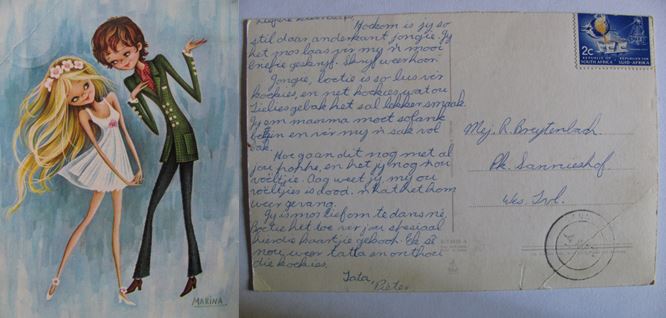
I grew up collecting postcards. It started when I went on a school tour in Standard 7 (now Grade 9) when I bought a few postcards of birds at the Transvaal Museum in Pretoria and more when visiting the Kruger National Park. I already had one postcard in my collection – dated in 1970 when I was almost two years old and he was in the Air Force already. It had a painted picture on the front of a pretty boy and girl and my much older, beloved big brother’s handwriting on the back, telling me that he missed me and that he was looking forward to come visit, so that I could bake him some cookies.

postcard Piet

From that school tour on, I bought postcards whenever we went somewhere and even had people giving me their old ones they wanted to get rid of. I had an interesting collection of postcards written in my native language, Afrikaans, English and even German. The German postcards were from a dear older friend at work who frequently received post from her family back in her homeland. I so loved those pictures of the many different places I longingly looked at. My father once visited Germany, Venice and Italy and my eyes were treated to more beautiful places. It must have been where the dream to travel the world started. Later on friends were asked to send postcards when they visited far off places and my assemblage got bigger. But, as I grew older and busier, looking at my postcard collection was limited to moving them to different storage places in the house every five years or so. Recently, when we moved to Egypt, I decided to donate them to a more suitable collector – our friend, Adri, who had a wonderful collection herself and actually spending a lot more time appreciating it.

I did keep a few postcards though. I kept that one my ouboet sent me so many years back and also a 3D one he bought on a school tour to the planetarium in the late 1960s. I also kept two precious ones that I got from my mother. Both were of uncles who fought in WWII in Egypt. The one had a picture of the Nile on it with a photo of the one uncle inserted in the upper right corner. The other one was of my mother’s uncle Koos Coetzer, posing next to an empty chair as was the fashion back them for some reason. I always looked at them, wondering what their stories were and what happened to them being so far away from home. The man in the inserted picture I was told, came back home safely, but committed suicide. The other one didn’t come back. He died in a foreign country, fighting for foreign people against foreign people in a foreign war.

two pcards

When we heard that we were moving to Egypt, I took a picture of the two postcards and decided that I will try to find out more, once we are here. We are supposed to attend the commemoration of the Battles of El Alamein in October, but we were fortunate enough to visit the place on a work related trip much earlier than I thought.

collage ElA

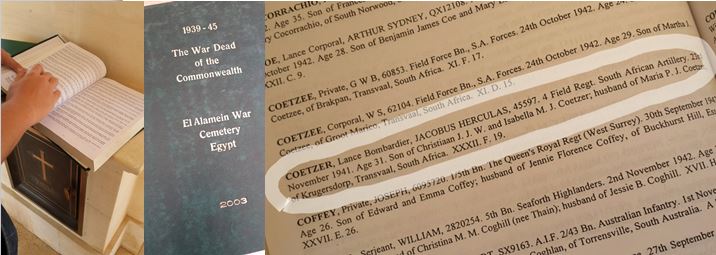
I did some initial research on the website to try and find my uncle’s information, but with no success. My mother got his detail from her cousin, but being a bit discouraged by my first unsuccessful attempt, I didn’t bother doing any research until two days before we went on the trip. I think I was delaying the search because I was afraid that I wouldn’t find anything. But in the end I got the information and searched. The reason I couldn’t find it initially it seemed, was because my mother had his names wrong, but she also got his service number and that did the trick. I found the inscription on page 71 of the records on the web page and with it his grave number. Something in me stirred. I didn’t know my uncle and I think I saw my aunt (his daughter) once before in my life, but somehow I felt connected to this young man who died fighting a fight that wasn’t his to fight and lost his life for it so long ago. I wondered if any of the family had ever been to his grave and I wondered how his death had influence his immediate family.

Although I was glad that I found the information, I was still a bit fearful that it might be difficult to find the actual grave when we get to El Alamein. Fortunately, my husband’s assistant and Mustafa, the man working at the cemetry knew the place very well and was very helpful. First, we looked up his name in the book and then Mustafa offered to show us where it was.

research

At this point of the story I must mention that I have a fascination with burial places from a historical point of view. Whenever we visit small towns I always like going to see who is buried there. Graves tells history like very few other things in life. Pilgrim’s Rest, Haenertsburg, Sabie and those places have ‘treasures’ with regard to the past buried in their grave yards. On the other hand, I hate visiting family graves. I hated it when my mother wanted to visit her mother’s grave in our old family grave yard on the farm on Sundays. My father and I would walk behind her with the flowers and the water and my father used to whisper to me:  “Please don’t ever do this when I die.” (I don’t.)

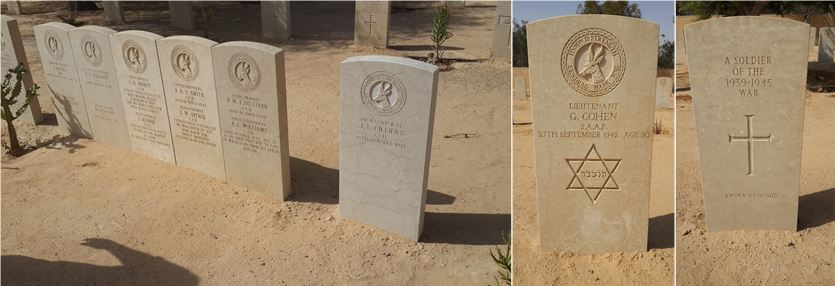
The place was really well kept and easy enough to navigate. We walked through the rows of precisely planted grave stones, in awe about the precision of stones. Being the Commonwealth burial site, there were graves of fallen soldiers from the United Kingdom, New Zealand, Australia and other Commonwealth nations. Christians and Jews were buried alongside each other. The first tears found its way through my lashes when I recognised the little Springbok head on a group of grave stones, planted ‘shoulder to shoulder’. South Africans. My own people. In the hard, dry Egyptian desert sand. I wondered briefly if they died shoulder to shoulder also or what the reason was for them being placed so close to each other.

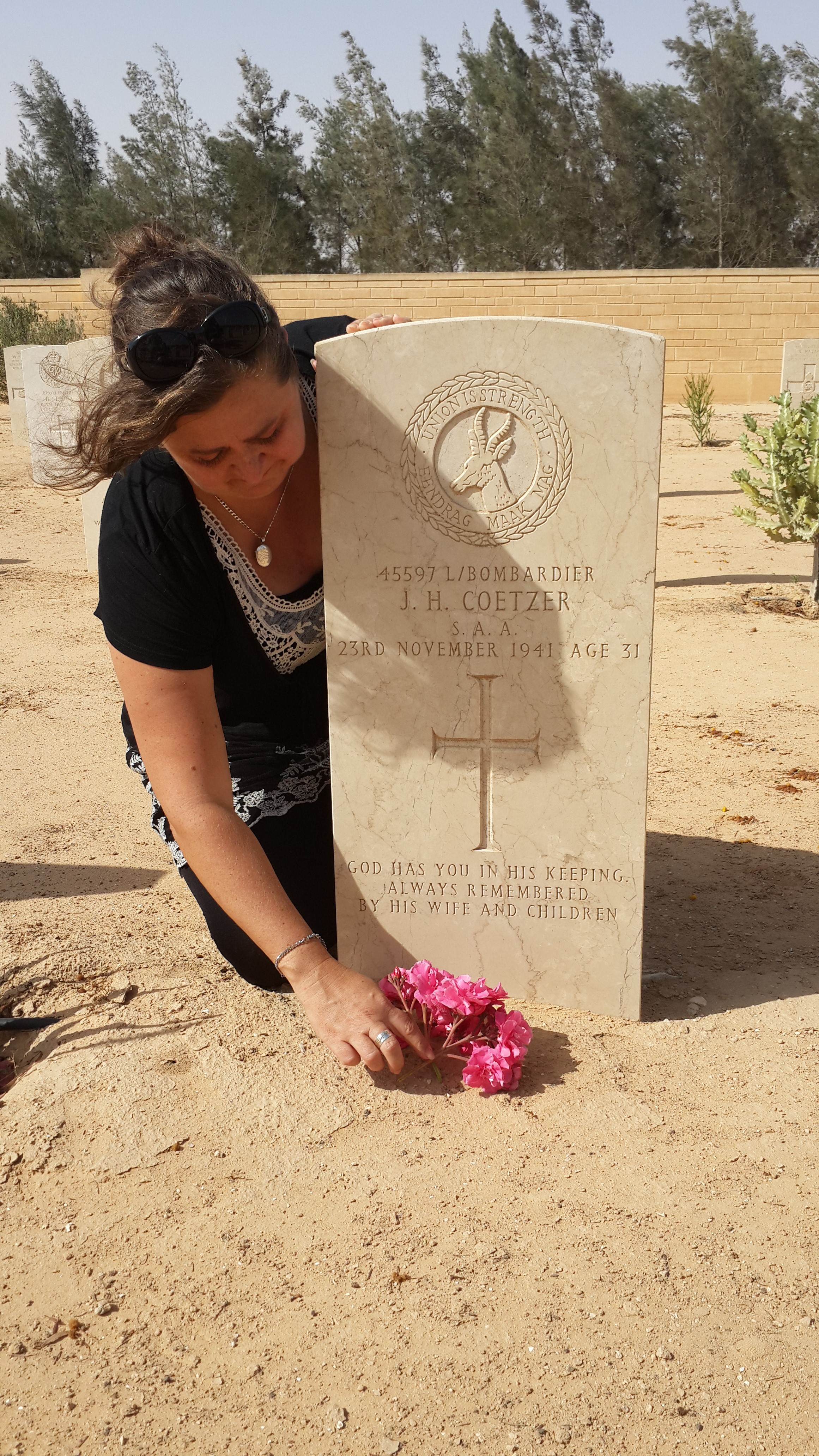
shoulderAt the fourth last row, I saw Mustafa, Muhamed and my husband, Deon, coming to a standstill. My heart raced. It was really there! I reached the grave and saw a name I have seen before on funeral letters back home of family members with the same surname. Blood of my blood. It was a strange feeling, standing there, looking at the grave of Jacobus Herculas Coetzer – knowing that he was buried there 73 years ago by strange hands. I wonder how his wife felt when she visited his grave in 1954. We were the only other family members as far as we know to have visited his grave. I wondered about his children, growing up without him, and his daughter, Isabel’s words from her WhatsApp message echoed in my head.  “…put a nice flower on his grave and tell him that’s from his little girl, now an old lady of 75. I was six months old when he left and two and a half when he died…

Capture

I didn’t have a way to get flowers before we came, so I was posing behind the grave when suddenly Mustafa appeared, in a typical wanting-to-help-and-not-even-being-asked-to Egyptian way with a hand full of flowers…

20140620_094058

For someone who doesn’t like visiting graves of family, this will go down in my memory bank as a pretty wonderful experience. Who knows, maybe Isabel will still have the opportunity to visit her daddy’s grave before she meet him in person one day.

Koos Coetzer

Watch my picture journal of our visit to the El Alamein War cemetery on You Tube at http://youtu.be/yOotbqRM6gM

For more information visit the Commonwealth War Graves Commission website at http://www.cwgc.org/.


© 2014 Riëtte de Kock

I am trying hard to be a Proverbs 31-woman – excellent wife, finest mom, greatest lover and successful entrepreneur and freelance writer all at the same time! 

Visit my website at www.thewritingclub.co.za and buy my children’s ebook, Yeovangya, on Amazon Kindle at http://www.amazon.co.uk/Yeovangya-ebook/dp/B008CP2RQ0

My Afrikaans blog is available on my website – or just click on this link: http://www.thewritingclub.co.za/writingclub/index.php?option=com_lyftenbloggie&view=lyftenbloggie&category=bloggies&Itemid=66


Rapid Writing – Tips, Lessons & Exercises from The Writing Club Facebook Page

Lesson 1


Click on the pic for better viewing

c   2014 Riette De Kock

  • This is a new initiative from The Writing Club © (https://www.facebook.com/thewritingclubdieskryfklub?ref=ts&fref=ts). It  will brings you regular ‘writing rapids’ in the form of very short lessons, tips and creative writing exercises.
  • Writing Rapids© will help you practice your writing skills on-the-go. All you need is your smart phone and 10 minutes at a time.
  • Don’t worry if you miss an exercise – just keep going. You can always scroll back to previous tips, lessons and exercises or catch them here on www.fieliesdekock.wordpress.com .
  • Feel free to post your exercises on the The Writing Club © Facebook page.
  • (Unfortunately no editing or advice on your writing can be offered from me right now.)
  • Please comment on the lessons, tips and creative writing exercises and post some of your own if you want.


Let’s get The Writing Club © Facebook page buzzing!

Tickld Mobile – English Isn’t As Easy As You Think. This Guy Nails It.

English Isn’t As Easy As You Think

This was shared on Facebook. Excellent 😉

http://m.tickld.com/x/english-isnt-as-easy-as-you-think

English Isn’t As Easy As You Think. This Guy Nails it.

You think English is easy?

1) The bandage was wound around the wound.

2) The farm was used to produce produce.

3) The dump was so full that it had to refuse more refuse.

4) We must polish the Polish furniture..

5) He could lead if he would get the lead out.

6) The soldier decided to desert his dessert in the desert..

7) Since there is no time like the present, he thought it was time to present the present.

8) A bass was painted on the head of the bass drum.

9) When shot at, the dove dove into the bushes.

10) I did not object to the object.

11) The insurance was invalid for the invalid.

12) There was a row among the oarsmen about how to row.

13) They were too close to the door to close it.

14) The buck does funny things when the does are present.

15) A seamstress and a sewer fell down into a sewer line.

16) To help with planting, the farmer taught his sow to sow.

17) The wind was too strong to wind the sail.

18) Upon seeing the tear in the painting I shed a tear..

19) I had to subject the subject to a series of tests.

20) How can I intimate this to my most intimate friend?

Let’s face it – English is a crazy language. There is no egg in eggplant, nor ham in hamburger; neither apple nor pine in pineapple. English muffins weren’t invented in England or French fries in France . Sweetmeats are candies while sweetbreads, which aren’t sweet, are meat. We take English for granted. But if we explore its paradoxes, we find that quicksand can work slowly, boxing rings are square and a guinea pig is neither from Guinea nor is it a pig.

And why is it that writers write but fingers don’t fing, grocers don’t groce and hammers don’t ham? If the plural of tooth is teeth, why isn’t the plural of booth, beeth? One goose, 2 geese. So one moose, 2 meese? One index, 2 indices? Doesn’t it seem crazy that you can make amends but not one amend? If you have a bunch of odds and ends and get rid of all but one of them, what do you call it?

If teachers taught, why didn’t preachers praught? If a vegetarian eats vegetables, what does a humanitarian eat? Sometimes I think all the English speakers should be committed to an asylum for the verbally insane. In what language do people recite at a play and play at a recital? Ship by truck and send cargo by ship? Have noses that run and feet that smell?

How can a slim chance and a fat chance be the same, while a wise man and a wise guy are opposites? You have to marvel at the unique lunacy of a language in which your house can burn up as it burns down, in which you fill in a form by filling it out and in which, an alarm goes off by going on.

English was invented by people, not computers, and it reflects the creativity of the human race, which, of course, is not a race at all. That is why, when the stars are out, they are visible, but when the lights are out, they are invisible

The Egypt Chronicles – New Residents in a Foreign Country

image

l (and my husband) never had the desire to emigrate from South Africa, but we always had the dream of living and working abroad for a while. Hopefully our only son will one day earn his living mainly in our country too. Through the years so many things in our lives and our country changed and we started to think that the possibility of working and living in another country was lost. But ‘out of the blue’ the opportunity came our way and we took it.

We love travelling and thought that if we lived somewhere ‘in the middle of the world’, travelling would be much easier. (Read less expensive.) We South Africans are mos eager travellers, but it costs an arm and a leg for us to travel.

To live in South Africa have more advantages that most South Africans realise. Ask any South African living abroad or who had lived abroad or who travel abroad regularly. At this point, please let me just state that I do not criticise people who emigrate. l can really, really, really understand it when people leave the country after they had been hijacked for the third time…

l am also of the opinion that migration is a very natural thing and that circumstances ‘moved’ people to emigrate throughout the centuries – in this instance the crime rate in our beloved country became most people’s moving factor. It was this ‘natural’ migrating phenomenon after all which brought our forefathers to South Africa in the first place. l believe the point is now made. So, let’s get on with us living in Cairo now.

It goes without saying that it is much different to holiday in a country than to live in it. We came to Egypt with the intent of staying and not holidaying. I think we got that one right so far. But, in spite of travelling via Cairo elsewhere six times before, and knowing what it looks like, I was still overwhelmed on our first night here. In my head I did the Maths: 4 x 365 days to go. l didn’t feel up to it. But, the next morning I woke and the fatigue from the flight was gone and so were the woes.

Let me put it in perspective for you. l grew up in a small town with a population of only in the thousands  – the then black township people included – of whom you rarely saw a few dozen at a time and where, according to statistics only 33.5 people live per square km.

For the past 26 years we had been living in Pretoria, a city with 1.7 million people. The whole metropolis houses plus minus 2.4 million (675.1 people per square km). South Africa has between 48 to 52 million people (according to different websites, none of which claims to be correct). Our new city, Cairo, ‘they say’ has 20 million people! In one city! That’s almost half the population of South Africa! In one city! Will you forgive me if I felt just a tad overwhelmed?

But like in most situations where one feels overwhelmed, it always helps to get your facts straight. According to the CAPMAS, the country’s official statistics body, Egypt has 86 000 000 people – excluding the 8 000 000 living abroad. (Yes, Hany, you were counted too.) It states that Cairo has only 9,12 million souls. ONLY. I feel much better now.  🙂 Although,thinking of sharing a square kilometer with 47 257 other people in the Cairo governate IS daunting. On the other hand – stats here are only manipulated numbers. There may well be living 20 million people in Cairo. The indications are there. Enough of the stats. I’m more of a words than a numbers person.

As it normally goes in life, one can adapt quite quickly. While Cairo seemed like a dull, chaotic, dusty, dirty place on that first day, l wake up every morning since then to be surprised by something new. lt is as if someone comes every night with a box of crayons – not paint yet, but crayons work for me so far – to colour a new piece of the city just for me. And when I come out on the hotel balcony every morning to see what the day looks like, I find that the water in the Nile in front of me suddenly has changed colour. And so does the agricultural patches across the river and the  trees on the the other side of the river bank. And even the desert and the pyramids on the horizon. And the cars and shops in the busy streets. And some of the scarfs on the woman’s heads.

When you keep calm and draw a breath and get enough sleep, the world around you seems to become a better place. Because then you have the awareness to be wooed by the views and the sounds and the sights and the people around you. OK, I admit that the sounds are still something to get used to, but the friendliness of the people overrides the bombardment of the forever-present hooting sounds and the forever-present howling sounds from the mosques or the forever-present sounds from the traffic in the streets.

Every South African living here, tells us that they enjoy it here and those that are leaving or had left already, told us that they are/were sad about leaving. l don’t want to think about leaving. We just left South Africa. I don’t have the capacity for more goodbye’s in the near future.

We’ve been ‘living’ in Egypt for two and a half weeks now. So far, so good. Hopefully we will move into a house soon and then the real ‘living’ can start.

I don’t want to bore you, so I will stop here for now. Thanks for being on this  journey with us – wherever you are when you read this.

2014 Riette De Kock

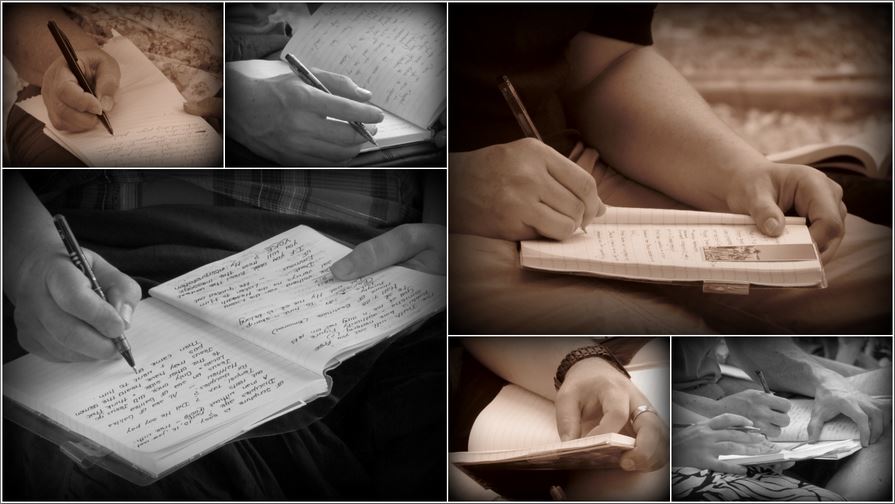
Article on Writing: Journal Writing

Capture1

I never travel without my diary. One must always have something sensational to read on the train.Oscar Wilde

(Read the previous blog – Thinking about Life – entry before this one at https://fieliesdekock.com/2014/03/17/article-on-writing-thinking-about-life/.)

People keep journal for different reasons and therefore there are various kinds of journals, such as spiritual journals, therapeutic journals, ideas journal, memoires, personal memories, research journals, journals keeping track of illnesses, art journals, travel journals, thank you journals, etc.

Why do People keep Journals?

The function of journaling is to keep record of information (or statistics/thoughts/memories etc.) regularly for later use.

The difference between journals and diaries (according to the website http://42explore.com/journl.htm) is:

A journal is a continued series of writings made by a person in response to their life experiences and events. Diaries contain a description of daily events. A journal may include those descriptions, but it also contains reflections on what took place and expresses emotions and understandings about them. It doesn’t matter what you call your writing, either a diary or journal, as long as you see the distinction between these two ways of writing.

Different journals have different styles. In some journals, like that of a researcher, a therapist, or a traveller, the writer must be meticulous about recording facts accurately to write academic papers, truthful articles or medical reports later on. In other journals used to record memories or spiritual growth feelings, emotions and thoughts play a more important role.

Examples of Journals

One can almost record anything in a journal and although there are more types of journals, we will look at only a few.

Spiritual Journals. Prayer requests (and answers) and notes on one’s personal spiritual growth, conversations with our Father in heaven and life lessons learned, are the basic aspects recorded in these journals.

Therapeutic Journals. Psychologists and patients can both keep record during therapy. Therapists will write entries about their patients’ progress and treatment, while patients will write down their emotions and thoughts and also about their physical wellbeing and/or symptoms.

Ideas Journals. It is a good idea if you are/want to be an artist, inventor or a designer to keep a journal where you can dot down your ideas. Painters or song writers find this extremely helpful. In today’s busy life, we tend to forget easily, but when you use a journal, all those wonderful ideas you have won’t go to waste if it is penned down immediately. These days, digital devices such as cell phones, laptops, iPads and tablets have memo pads, voice notes and apps available which come in handy to quickly type or record a thought for later use.

Memoires. Many people, especially famous ones, want to write their memoires or autobiographies in the future. Keeping a journal helps one to preserve important memories. (Keep in mind that there is a difference between autobiographies and memoires.)

Research Journals. Scientists, archaeologists, journalists, statisticians, mathematicians etc. normally keep journals wherein they record their research and findings for later use.

Progress Journals. Teachers, scientists, project managers etc. use journals when monitoring the progress of projects.

Medical Journals. People who are seriously ill use journals to keep track of symptoms, treatment, reaction to medicine, etc. Doctors do the same when monitoring illnesses or researching new treatments.

Art Journals. Artists use journals to plan paintings, write down ideas for art pieces etc. It helps them to plan projects which they cannot work on right away.

Travel Journals. Journaling helps travel writers (or just for-fun travellers) to write down important notes while travelling, on detail such as routes, costs, contact numbers, addresses, web site addresses, names of people and places etc. They can also use their journal to keep track of pictures taken.

‘Thank You’ Journal. Some people like keeping a journal of the things they are thankful for. It is a wonderful way to learn to write regularly and it also helps a writer to always be on the lookout for something to write about and a good way of learning to be thankful for what you have.

Dream Journal. Some people record their dreams in their journals just after they have woken up. Some dreams have meaning and it helps people to write down their dreams before they forget them.

‘Diary’ Journals. It is a journal containing daily events, thoughts, feelings, dreams and sometimes, even secrets and is normally the first step in journal writing people start at a young age.

Tips on Journal Writing

  • Make your own rules. If you want to write every day, it is up to you. If you only want to write in your journal twice a week or whenever you feel like it, that’s okay too. You can write long, thoughtful pieces at a time or only two sentences. You can write, draw, design, glue pictures in it or do whatever you like. You are a unique person and only you know what you want to preserve in your journal.
  • Always keep your journal and a pen/pencil/phone/tablet near – in your backpack, schoolbag etc. so that you can write down an idea when it pops into your head. If you don’t write it down, you will probably forget it. Otherwise know how your cell phone’s memo pad and voice recorder works.
  • Write the date at the beginning (or end) of all your entries. This will help you especially if you need to write factual pieces or even your memoires later on.
  • Don’t stop if you haven’t written for a few weeks. Just keep on where you left off. Remember, you make your own rules! I have moved from writing in a notebook to keeping a journal on my computer and I don’t write every day, but I keep writing. My current digital journal is almost eight years old and include my thoughts, struggles, experiences, travel log and even world events, because they also influence our lives.
  • Don’t try to impress anyone in your journal. It is a personal thing and it is about your personal growth. You don’t have to try to perform when writing in your journal. Be honest with yourself and write from your heart. Write about all your fears, emotions and your losses in life, as well as about the things that make you happy and the dreams you have for the future.
  • If you keep a spiritual journal, provide space where you can later come back and write down answers to prayer, i.e. write on the one side of your journal and keep the other open.
  • As already mentioned, you can also keep your journal on your PC/laptop/iPad/tablet/smart phone. Just make sure that you make back-ups regularly (preferably in the cloud, rather than on a disc you can lose or that can break) and keep an extra notebook to take with you wherever your computer can’t go with you.
  • You don’t have to let anyone read your personal journal.

You don’t have to limit yourself by having a separate journal for every different aspect of your life. You can use only one book to record all the different facets of your life. I have two journals – one for my personal thoughts etc. as mentioned above and another that I use as a notebook for writing poems, jotting down story ideas, planning dinners and recording admin. That way I only grab one book when leaving the house and I don’t need a trailer to transport all my journals every time I go somewhere.

I also have a WhatsApp group with myself (with my phone and tablet names) where I write when I have no other way. That way I can transfer my thought electronically to my journal when I get home without having to type it again.

Did you Know?

  • Journals had been used to record history. Many famous as well as unknown people had kept journals, recording important historical events and so preserved history that otherwise would have been lost.
  • Some journals had been published as books (like Anne Frank’s).
  • Secrets in people’s diaries or journals had led to crimes being solved, lives being saved, conspiracies brought to light and it lead people in love to each other after years of being apart…

Famous People who Kept Journals

  • Louis Tregardt, (yes, that’s how he wrote his surname in his diary) Voortrekker leader. He recorded how the Voortekkers trekked and the battles they fought.
  • Anne Frank was a girl who lost her life in WWII. She called her diary ‘Kitty’ and had various ones. Only ‘Kitty’ diary was later found and published by her father.
  • The famous author of Alice in Wonderland, Lewis Carroll (alias Charles Lutwidge Dodgson) kept quite a few diaries of which some had disappeared.
  • The English novelist, Virginia Woolf, was another keen keeper of journals.
  • Most U.S.A. presidents kept journals, including George Washington, John Quincy Adams and Thomas Jefferson. However, one unique diary belonged to Harry S. Truman, who wrote in his diary constantly, recording notes on and even his feelings about every appointment he had during each day!
  • Even fictional people like the TV character, teen doctor Doogie Howser, wrote two sentences in his diary (on computer) each day. So did the movie characters, Bridget Jones, Mia Thermopolis (The Princess Diaries) and Indiana Jones, who recorded treasure maps and notes about important artefacts in his.
  • Song writers are keen on journaling. They write down songs that sprung into their heads at strange times of day (or night). One of them is Jessica Simpson.

Who knows, maybe one day, I will add your name in an updated version of this blog…

Creative Writing Exercise

Write a 10-minute journal entry in your current journal or in a note book if you don’t have a journal yet. Write from your heart. You can write about something you did or about something that you feel sad about or something that makes you very happy or something that you are thankful for or all of the above! Or write down your love story, or write about your dreams, places you want to visit etc.

Some Last Notes

Remember to write the date with every entry.

Try to make at least two journal entries per week from now on. Schedule a special appointment with yourself on a Saturday/Sunday afternoon and one week morning/night.

Happy journalling!


(Read the previous blog – Thinking about Life – entry before this one at https://fieliesdekock.com/2014/03/17/article-on-writing-thinking-about-life/.)


©2007 Riëtte de Kock   


Article on Writing: Thinking about Life

 ???????????????????????????????

*  This blog entry is introductory to next one about journal writing. Read it at https://fieliesdekock.com/2014/03/17/article-on-writing-journal-writing/

To be a good writer, one must have a ‘writer’s voice’. To have a ‘writer’s voice’ it is important to have opinions about lots of things in life. To have opinions one must spend a great deal of time thinking about various subjects and issues.

We are Spirit within a Body

A human being is not only a piece of meat filled with bones and blood and water. Man consists of body, mind and spirit and soul. We are complicated beings. We must understand that we don’t just have a body to look after, but also a spirit/soul/mind. Not only needs our body to be fed with food, but our spirits also need food. Most people are religious and believe in some or other god. I for instance, believe in the Living God of the Bible. So for me to become a whole human being, I need more that only food for my body. I need to learn of and communicate with God in order to feed my soul/ spirit. We are spiritual beings in fleshly bodies.

Making Sense out of Life

Sometimes things happen that don’t make any sense to us and true to our human nature, we want to make sense of it. Sometimes we talk to a trusted friend about it and sometimes we keep it to ourselves. It happens to every person at some stage. It is good to talk to someone about our problems and worries and concerns. But sometimes there isn’t anyone to talk to. Or we don’t want to talk to anyone about certain things. What to do then?

Dreams and Goals

Apart from experiencing things and having fears and problems, we all have dreams and goals in life too. Those dreams and goals will not just happen without us doing something to make it happen. Therefore it is good to think about the things we want from life and write it down – because when we write things down, they start to become real in our minds.

If you don’t think about life and what it is that you want to do, then you will probably end up doing whatever comes along and not what you are supposed to do with your life.

We all have different dreams, talents and passions. Unfortunately, there are many people today who don’t know what their life’s dream is, because they never take the time to think about life and to learn to know themselves. Don’t let that happen to you.

It is therefore important that we learn to know ourselves – our dreams, talents, passions, short falls and behavioural patterns. Just as a sportsman have to practice every day to become fit and to master every bit of skill there is to master in his sport, so we have to ‘practice’ every day to become the best we can be.

Only you can be you, so be the best you you can be.

(Yes, I know it sounds cheesy and I don’t know if someone else had said it before.)

How do we go about Becoming the Best we can be?

By thinking – thinking about ourselves, our behaviour, the way we handle things and the way we don’t. By thinking about things that are important to us, things we don’t like or things that we do like. By thinking about what we want to do for others and for ourselves. And by thinking about our points of view on different issues we hear about on the news, such as global warming, abortion, human rights, world politics etc.

Make Time to Think

These days we seem to be too busy to think. We have school or work, sports, chess practice, piano or violin lessons, extra maths classes and then we still have to watch TV and DVDs, listen to music, go to the movies, keep up with our Facebook and Twitter friends and do homework. It’s exhausting!

We don’t have time to become quiet and listen to ourselves. That way we get used to other people thinking for us and making decisions on our behalves. Teenagers wear what Hannah Montana wears and listen to Justin Bieber because they are told to listen to him.

Children make their parents buy them toys they can’t afford, because the TV ads say that everyone must have them. But do all girls really like to look like Hannah or like to listen to Justin or do children really need those expensive toys?

Most children today don’t know the answer to these questions. They just do as they are told because they don’t know what they really like, because they don’t think for themselves.

The same applies to adults.

Introduce Yourself to Yourself

I want you to make a stand and change all that today. I want to encourage you to start thinking for yourselves.

Make time every day to spend thinking. It can be early in the morning (if you are an early bird) or in evening before going to bed. Or somewhere in between. Go to your room and switch off everything so that you can hear the quietness. (And leave your cell phone in another room.) Or go outside and sit or lie on the grass or sit on the porch. (And leave your cell phone inside.) Just be quiet and allow your thoughts to flow naturally. Eventually you will start thinking about the things that are important to you. Keep a notebook or your journal close and write done things that you don’t want to forget.

A Few Exercises to get you Started

  • Make a list of the people you love most.
  • Make a list of the people you don’t like hanging out with.
  • Make a list of the things you like doing most.
  • Make a list of the things you really don’t like doing.
  • Make a list of your favourite subjects at school/favourite tasks at work.
  • Make a list of your least favourite school subjects/least favourite tasks at work.
  • Make a list of five things you want to do in life (like climbing Mount Everest or run the Comrades Marathon, writing a book etc.)
  • Make a list of ten places in the world you want to visit.
  • Make a list of your five best character traits.
  • Make a list of your five less attractive character traits.
  • Make a list of five things you think you should become better at.
  • Write down five nice things about every person in your immediate family. (Yes, everyone.)
  • Write down five jobs you think you should like to do/ had done.
  • Write down five things you like about your best friend.
  • Write down five things that you would want your friends and family to say about you.

Creative Writing Exercise

By doing a few of these exercises you will be ready for the following blog entry on journal writing. Read it at https://fieliesdekock.com/2014/03/17/article-on-writing-journal-writing/

  • Take a 20-minute thinking session on your bed or outside in the garden. Take a notebook with you.
  • Do at least two exercises on the list above in your writing club journal.

For more writing related articles, follow The Writing Club / Die Skryfklub on Facebook at https://www.facebook.com/thewritingclubdieskryfklub/?ref=bookmarks


©2007 Riëtte de Kock    

Movie Review – The Book Thief

http4.bp.blogspot.com-_Rnc5HkAbcIUn28BPkSTZIAAAAAAAAAT8894N1p9O8e4s1600BookThief-Poster.jpg

httpswww.google.co.zaurlsa=i&rct=j&q=&esrc=s&source=images&cd=&cad=rja&docid=b-5SO3BwZnsq3M&tbnid=tlBtrTh3ckGQyM&ved=0CAUQjRw&url=http%3A%2F%2Fwww.empireonline.com%2Fnews%2Fstory.asp%3FNID%3D36407&ei=VLf

The original novel by Markus Zusak

In spite of luke warm reviews from overseas (and some local) reviewers and reading the book (after which one normally is disappointed with the movie), I really enjoyed watching The Book Thief. The story is narrated by ‘Death’ and is the account of a little girl’s WWII experiences. Liesel and Werner Meminger is sent to a couple living in the city – a heart breaking, but selfless act by a mother to save her children’s lives. Her brother doesn’t survive the trip and Liesel ends up alone with Hans and Rosa Hubermann in Himmel (heaven) Street.

Liesel’s last physical memory of her mother and brother was a book she picked up at little Werner’s grave and kept for herself. Thus her book thieving ‘career’ started – in spite of the fact that she couldn’t read. While her relationship with her new mama starts on the wrong foot, it was Hans with whom she clicked instantly and with whom she discovered the freeing world of words.

The Book Thief is a bitter sweet story, full of heartbreak and joy and although it isn’t an all-guts-and-blood version of the war as some movie reviewers seemingly wanted it to be, it is a wonderful story of love and loss and growing up and survival. It is especially delightful if words spin your world too.

The book is one of the most special and weirdest I’ve ever read, and yes, even if a movie can never satisfy as a book does, this movie is a good try. Maybe the reviewers are so used to being fed Hollywood ‘recipe’ films and remakes of remakes of remakes that they can’t recognise a good story anymore if they see one. Liesel’s story certainly remained with me for quite a while and is in fact still lingering in my mind.

The cast is excellent, with Geoffrey Rush his brilliant self as Hans Hubermann, and Emily Watson giving spunk to Rosa. Nobody else could have played Liesel, but Sophie Nélisse, with her large, sparkling, innocent, blue eyes. Nico Liersch playes the lovable, self-confident, scared Rudy with the experience of a veteran, and Ben Schnetzer is inspirational – dancing alone under the stars while all the non-Jewish residents of the town hide away in their bomb shelters during an air raid.

The movie already won three awards and is nominated for seven more. (It is nominated for one Academy Award (Oscar.)

Read the original book by Markus Zusak. Read the original book by Markus Zusak. Read the original book by Markus Zusak.

I declare it a 5/5 movie. (See legend at the bottom.)

c 2014 Riette De Kock


Actors: Roger Allam (narrator), Sophie Nélisse, Geoffrey Rush, Emily Watson, Ben Schnetzer, Nico Liersch

Age restriction: PG13

Director: Brian Percival

Writer/s: Markus Zusak (novel), Michael Petroni (adaption)

Music: John Williams

Cinematography: Florian Ballhaus

Parental Advice: Always keep to age restrictions.

Language: Swearing, war violence.

Nudity: None.

Sex: None.

Violence: War-like violence occurs.

Offensive Stuff: Prejudice, anti-semitism is portrayed, but not promoted.

5/5 Don’t miss! Do whatever to go and watch the film!

4/5 Good, very watchable, but it may have something to put someone off, or may just not be your cup of tea.

3/5 OK, but if you have something else to do, reconsider and watch it when it comes out on DVD or on TV.

2/5 Pff, why would they waste time to make it and why would you waste your time and money to go and see it?

1/5 Don’t even bother. You have to be paid to watch this and then be recompensed for your time.

0/5 Need I waste words?

Memory Lane Chronicles – Memories of a House

IMG_7789

Us three and our Maltese, Simson – Dec 2013

October 1996

It was the first time that Michael cried after an immunisation. Really cried. He was six weeks old and he was quite cranky from the redly swollen bumps on his little upper legs. He was lying on my lap in the back seat of the car while we waited for my husband, Deon, and parents to finish their tour of the last house on our estate agent’s itinerary for that day. We sort of decided that we would make a bid on the previous utterly boring house we saw, although there had literally been nothing but grass in the garden and it only had one garage. The house didn’t make me excited at all, because it was dull and unimaginatively designed. But it did have nice wooden kitchen cupboards. There hadn’t even been weeds! With a crying baby on my lap, I was waiting eagerly for them to return, so that we could go home to bath Michael and get him to bed. I wasn’t much interested in looking at another house when we already made up our minds.

Michael kept crying. And Deon and my parents stayed away. I was getting panicky, because I haven’t experienced this side of our baby boy so far. My father threatened to take him to the doctor to test his lungs because he was sure that he wasn’t able to cry. Where was he now?!

After what felt like a lifetime they came out of the house and Deon announced unceremoniously that we are buying the house. I ran inside for a quick peek, but didn’t really look at anything, because my mind was back in the car with our crying baby.

A week later Deon took me the house again, seeing that he bought it on both our behalves – something he never did before and something he would probably never do again. We normally take all decisions together after talking for too long about it and weighing too many options. I have learned during our 22 years of marriage that Deon usually takes a loooooong time to make decisions. He is never hurried into anything. I also learned to trust his long way of decision making, because the few times I tried to rush him, things didn’t work out so well. So nowadays I wait patiently (making my own plans in my head so long) until he is ready to make a decision and then I reveal my plans too. This way works for us. And I have learned A LOT about patience in the process – a lesson I needed to learn.

My parents moved into the house in the first week of November and we followed shortly. It was a rather different thing to live with parents in the house, but at least Michael enjoyed it later on, having his Oupa Wynie around. He would have him around for only another three years before he died in May 2000.

It was quite weird to move into a 300m² house from a 71m² simplex. It felt like walking kilometres through the hall to get from our bedroom to the kitchen, given that our previous little nest didn’t even had a hallway at all. I caught myself doing it just for the fun. It had been ten years, after all (of living in school and army dormitories and then in the small simplex), since I lived in a proper house with space again. And I loooooved it! In the sitting room I thought we needed a loudhailer to speak to each other. But we got used to that very quickly.

I was so happy, because both Deon and I grew up in small towns with large enough houses where we had enough space to live and play in. We wanted a house where our son could have a lawn to to play on and a garden where he could build mud houses and towns for his cars. He did all of that. I have scores of pictures of him over the years playing cars with friends in the mud. There are quite a few of his toys accidentally buried around the garden. Another few was eaten by our dogs over the years as we sometimes found the evidence when picking up poo! There is even a mosaic piece hanging in the garage now made of a broken little army figurine that we found after the dogs played with it.
IMG_6533

My father and mother moving in – Nov 1996

IMG_6535

Our house was a normal three bedroom house, with an open sitting and living area, a kitchen, two bathrooms and a study. There is also an outside room with a toilet. I made lots of plans to convert that into a granny flat over the years, but it never realised. Our house was quite full with my parents living with us, because we now had two of almost everything – two fridges, two microwaves, two tumble driers etc. My parents didn’t really understand the concept of letting their extra things go. It’s hard to stuff two households’ belongings into one house. So, in the end, we got rid of most of our things and they kept theirs. At least that would make our moving out easier one day we thought at the time…

8 September 2013

Michael turned 17 two days ago and it had been almost so many years since me have moved into our house. The reason for me writing this is because we are getting ready to move out. We always thought that we would stay here until Deon retires and we move to the Cape, but he accepted a position abroad for four years and if everything goes to plan, we will be moving within the next two months.

Looking back now, our house had fulfilled its purpose. We wanted a place where our son could grow up and have enough space to play and that happened. He was almost grown up now, standing 1,94m in his number 12 shoes and since his three little friends relocated to Mauritius nine months ago, he doesn’t play with cars in the mud anymore. That was replaced by virtual car games on his computer.

In the last few years we started feeling itchy. We were ready for a change. And now, it seems to have come. Although we are ready, we are also a little bit scared and sad to go, because this house was our home for so long. It had been the only place Michael had known as ‘home’ his whole life. We brought him here as a two month old baby and everything he learned and experienced was from the safety of this piece of earth. Here, he started talking and walking. Here he lost his teeth and waited for them to grow back – something which took seven years, since we had to get his front teeth pulled at age one. Here he brought his friends to play, had a lot of joys and also a few heart aches. Here he had his seventeen birthdays as a child.

This house became part of so many experiences over the years. Our gates changed from heavy manuals, to machine operated and so had the garage doors. We broke a door into our sitting room from the garage to make our coming in late at night safer in our crime ridden city. The furniture hadn’t change much over the years, but their arrangement did s-e-v-e-r-a-l times.

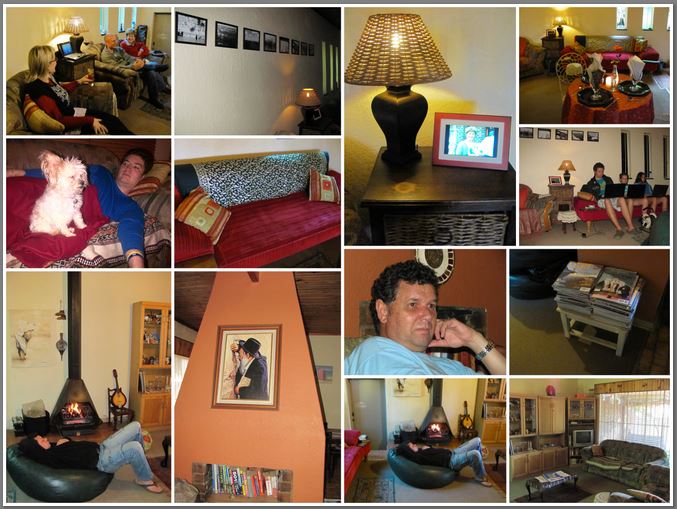
huis sitkamer

The sitting room

In our sitting room, we had wonderful times kuiering (spending time) with friends and family – in summer with the doors wide open and in winter in front of the fireplace. We watched TV and movies together and Michael played with his Playstation and wooden building blocks and Lego’s on the rug. The rug is a silent witness to life happening accidentally – from stains left by milk from baby bottles to coffee, cold drink, wine, mud feet from children and dogs and other spots that found their way there without us even remembering how.
huis eetkamer temp

The dining room

In our dining room we had family meals and many, many wonderful Sabbath meals with friend on Friday evenings, enjoying the most delightful dishes and even better conversation and fellowship. We exchanged stories and listened to joyful and heart breaking stories. We laughed and sang and cried and prayed and laughed even more.

huis study temp

The study and our place of schooling

The study is adjacent to the dining room and the first room when you enter our house through the front door. My mother used it as a storage space for most of the time, until we ‘won’ back the territory a few years back when Deon was attending a course and needed working space. After that, Michael and I moved in to do our schooling there. (He is home-schooled since he was in Grade 5.) It wasn’t a place where we spent much time before that, but since we started to work there, we had quite a few hundred hours of hard work and some good conversations and much laughter there. It is also the coldest place in the house in winter – just a hair breadth after Michael’s room.

huis kombuis

Kitchen activities

Our really, really ugly, brownish kitchen were transformed into a beautiful, inviting place some years back. In there I cooked meals just for us every day and on Fridays for our guests with a light and happy heart. It is there where Deon and I had kissed many more times than I can count and where Michael and I danced our silly, for-our-eyes-only steps to the music on the radio. It was also there where I taught him to dance before his cousin Karien’s wedding last September. I loved the view from the kitchen’s window on our garden’s gazillion colours of green and I loved to watch the birds sipping water and nibbling on the seeds we put out for them. Sometimes doves mistakenly crashed into the window and left their whole body print in a beautiful, fine silvery powder on the glass. The view from the kitchen window will be one of the things I will miss most.

huis gang

The hallway

One almost never tend to think about a hall as a room or part of the house, but in some instances it is the most important space of the house, because without it, there would be no way to reach the private inner parts of a home. Our hall was lined with family photos, reminding us of our loved ones when we pass by, sometimes without really acknowledging them. It was maybe the most used part of the house, seeing that we all had to move up and down through it to get in and out many times a day. So, even of our hallway I have fond, and some not so fond memories.

A good memory is one of Michael racing up and down on his little black kick scooter which made a huuuuge noice! He had to be very careful not to bump into the wall at the end of the hallway or into the little table in the corner, on which my favourite vase, which Deon brought from Malawi, stood. But he was a skilled little racer and the dangers at the end of the hall only honed his skills. One night my sister came to baby sit him and his little girl friend, Nini, and her brother and sister, while we and their parents went out to attend a function together. The two of them raced on their scooters again and Nini crashed into the little table, sending the vase flying over Michael’s head behind her – according to my sister’s very colourful account of the incident. It must certainly have been something to see.

Unfortunately, my most vivid memory of the hallway, is one I wish never was. It was on a seemingly uneventful, sunny November Monday afternoon in 2002, when I had to tell my mother, unexpectedly coming out of her bathroom into the hall, that her firstborn son was killed by an accidental explosion that morning. I will never forget the disbelief in her face and her hysterical voice. Neither the disgust in her eyes towards the messenger…

Even the guest bathroom, which served as my parents’ and later only my mother’s bathroom, was responsible for some memories. The tricky door knob, temporarily jailed friends and family until we learned to recite the “Pull, don’t turn!”-warning to every visitor for seventeen years! Why we didn’t ever think of changing the door knob, no one knows.

My parents occupied the first bedroom in the hallway, just opposite the kitchen. When I think of my dad, I always remember him where he was working on some project in the garage or in his little Wendy house or lying on their bed, either reading from his Bible, or asleep with the still-open Bible on his chest. The bedroom’s furnishings changed after he died when my mother bought a smaller bed and moved her sewing machine and a series of other furniture in and out regularly.
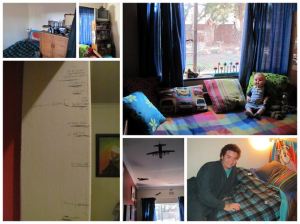
huis miq kamer

Michael’s room

Next to theirs, was Michael’s bedroom. We painted his room in joyful blue and green colours after we moved in. It stayed that way until he became too tall for his bunk beds last year. Then we renovated the room in a hint of broken white with one half-wall painted red, where he hung the paintings he made in the past two years. His Bob the Builder-bedding was replaced by a black duvet with all the colours of the rainbow-strips. Being on a tight budget, we couldn’t afford new furniture, so he saw off the feet-end of his bed and used the bed he doesn’t sleep on as a couch in his room, covering it with a very jolly blanket of colourful blocks and lots of colourful cushions.

Through the years toys indicating his age, filled the room. First there were over-sized plastic cars, soft toys and Duplo blocks. Those were eventually replaced by toy boxes choc-n-block full of smaller cars and hundreds of Lego block pieces. He collected a whole series of little army figurines and armoured cars, a tent, a helicopter etc. The collection of model planes hanging from the ceiling expanded through the years. Since the room makeover last year, all that remained visibly were the hanging planes, books – he became an avid reader in the mean time – and his Playstation games, along with Japsnoet, his favourite soft toy dog who had been with him on all our international trips, lying on the coach between the cushions. The other toys had found their way into his cupboard, waiting behind closed doors to be dispatched to other tiny hands to play with them. Maybe it will be the little hands of Michael’s children one day… (This paragraph sounds pretty much like the plot of Toy Story 3… J)
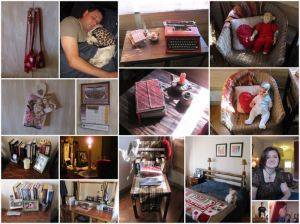
huis ons kamer

Our sanctuary

Our room had always been our sanctuary. Because my parents lived with us in the house, privacy had always been limited. As a baby and little boy, Michael slept with us in bed regularly – something we enjoyed and encouraged, since the inner-workings of a one-child family is much different from than that of a family with more children. A king-size bed comes in very handy in such circumstances and we enjoyed and treasured the intimacy of our small family.

Later on Michael practically moved in with us, arriving every night with his mattress and linen dragged behind him from his room and being placed next to his daddy’s side of the bed. When he was sick, he however joined us in bed again. One morning, at age 11 and a half, he and his mattress left our room, not to return again. He had become a big boy and we only lured him back to our room a few times after that when he was sick and coughing. Then the warmth of our bodies seemed to drive away the coughing and we could all get some much needed sleep. But not anymore. He stays on his own room now when he gets sick. Mamzi still has to go and give the meds and rubs in the Vicks on his chest though…

Our room’s looks also changed much during the years. When Michael was still small, I had a desk in the room and sometimes I wrote there, looking up more than necessary, just to stare at the sun lighting the garden outside.

Deon and I have many wonderful memories of our room. But we also had times of sadness due to family matters and illness. I spent boring, boring weeks at a time in bed after recovering from two major operations and had to nurse many migraines in there – something I am thankfully been cured of now, which I can only thank our heavenly Father for.

huis buite2 temp

In the garden at the back of the house

huis buite1

In the front garden

honne

Our beloved doggies

When we moved into our house, our garden had the second most beautiful lawn in the neighbourhood. Only Piet, three houses to our left, had a better looking lawn. That’s probably because he fed it well and mowed it twice a week and kept mowing it during the winter too. He still does. There were also lots of bushes and trees in the garden. Eventually we built a lapa (a shed-like wooden structure) in the back garden. The floor was finished just in time for Michael’s second birthday. Everyone visiting, pitched in and hammered at least one nail into a plank or saw a piece of wood. We made little wooden squares and whenever people came to visit they wrote their names and a message on it and nailed it to a beam. Years later we got people to put on a new roof and they didn’t mind the squares. Three of them came off, of which we found two. The one that was missing was that of my late brother…

In the last few years we built a new flat braai in front of the lapa, but it is on the road’s side and sometimes it didn’t feel so safe to sit there late at night. We built another fire pit in the garden at the kitchen’s side. Deon put in some lanterns in the tree and now we have a wonderful, cosy place to braai and spend time with friends with. Unfortunately, the trees in our garden grew so large that the shadow killed most of the grass. The rest of it was trampled by our three large Labradors! We planted grass again a summer ago, but it didn’t make it either. So now we have our own little desert in our back yard.

I try to take mental pictures of our house and our garden – of the many greens I see through the kitchen windows, of the bougainvillea crawling over the lapa’s roof and of Sherlock, Sasha and Sheva, our little dog family, who – like our small family – does everything together and who would be lost without their Alpha dog, Sherlock, as we would be without our Alpha ‘dog’, Deon. And of Simson, our little Maltese poodle, who is the apple of our eyes.

huis garage1

Michael working in the garage

Our garage had been a place where Michael was taught to fix things. My father fixed broken things, rather than doing away with them to get new ones. Together they fixed a lot of stuff, before Oupa left for heaven in 2000. At age fourteen, Michael started playing around with the tools and helped with quite a few building and restoration projects. He loves ‘playing’ in the garage and I find him them on many occasions, making a new sword or a kierie or something. I also spent a lot of time there, working on my father’s home made work bench, sometimes just hanging around there, remembering him.

IMG_3504

Our Bakkie and our 21-year old beamer (read Michael’s blog about the beemer at http://www.michaeldekock.wordpress.com)

We are going to miss our house – our home for seventeen years. It is the longest that Deon, Michael or I had ever stayed in one place – alone or together. For Michael it is the only house he had ever known. For us it was a place of struggle and sometimes sadness, but overall it was a place of happiness and joy. So much had happened to us and around us and in the world while we lived here, but our house had always been our safe haven. We made so many good memories while living here – enough to take with us and carry around with us for the rest of our lives. We can only pray that the people coming after us will be as blessed and happy as we were and that they can call it home for as long as they need to. And that they will be good friends for the wonderful neighbours we leave behind and who we will miss greatly.

IMG_1127

IMG_1192

Autumn

IMG_1120

Our street became a wonderland of reds and yellows and oranges when summer changes into autumn. People drive by to see the leaves on the huge old trees change and to take pictures to capture the beauty. I hope my mind had captured the beauty of our street in autumn, because it is absolutely gorgeous.
IMG_3497

IMG_3523

The three of us changed much over the span of seventeen years. Baby Michael became a toddler, a boy, a young man. Deon and I grew older and even more in love with each other. He gained a few grey hairs and I a few pounds. We leave here wiser than when we moved in. We can only pray that we will be as safe and happy and blessed – or even more – where we are going as we were here. We know what the past held, but we don’t know what waits in the future. All we know is that a new season is dawning and as a family we are embarking on it together. And we will do it with our eyes and ears and hearts fixed our heavenly Father, because He knows our future and to Him there are no surprises.

IMG_3483

Thank you, house, for the wonderful memories that we can take with us. We will always, always remember. May faith, hope, love, peace, happiness and safety always reside within you to give joy and refuge to those who dwell here after us.

Slide1
© 2014 Riëtte de Kock

I am trying hard to be a Proverbs 31-woman – excellent wife, finest mom, greatest lover and successful entrepreneur and freelance writer all at the same time! I share a living space in Pretoria, South Africa with my husband, son, mother, four dogs and sometimes the neighbours’ cats – and my head with way too many ideas and multitudes of story characters.

Visit my website at www.thewritingclub.co.za and buy my children’s ebook, Yeovangya, on Amazon Kindle athttp://www.amazon.co.uk/Yeovangya-ebook/dp/B008CP2RQ0

My Afrikaans blog is available on my website – or just click on this link: http://www.thewritingclub.co.za/writingclub/index.php?option=com_lyftenbloggie&view=lyftenbloggie&category=bloggies&Itemid=66

Things I Learned from Waiting and being ‘Homeless’

download

A little more than a year ago, an opportunity to work and live abroad for a few years, came our way. We embraced it and since then we have been on a journey of waiting. I know. A journey needs motion, you would argue. Well, life’s journeys sometimes take place a very, very, very, very, very slow pace. Probably because some of us learn so very, very, very slowly. Or maybe God just have other plans. Anyway, we waited to hear if the opportunity was real. We waited for my husband’s appointment to be signed. And now we wait for an accreditation process to come through so that we can leave.

It doesn’t sound very daunting, but between the above mentioned activities demanded – and is still demanding –  a l-o-t of patience from our side. There was the wait to hear if, then the wait to hear where, then the wait to hear if again and now the wait to hear when. Again.

I always knew that I was a little bit impatient, but I never, never, never, ever thought that I needed such an intensive course in Patience. I think we (read ‘I’) made it through 101 and 102 and 103 and even the honours degree, but I’m telling you that the Master’s is another story.

It is January now again and the thumb suck date to leave was at the end of November. We prayed and we planned and we worked and we planned and prayed more. It is very difficult to plan ‘in the air’ – without having a target date. One of our colleagues were eventually sent out middle December and two more are in the process. So, it seems that there is movement.

We did what we could, working with the end of November/December scenario. Our house was sold miraculously (really, but that’s another story for another day) quick and we moved out at the end of November, but there was still no determined leaving date. So, we took an unplanned, but well deserved holiday to see our family in the Cape and enjoy the sea. It was marvellous, although the uncertainty hovered in the back of our minds the whole time. It was more than okay though, because we were on holiday and met with wonderful friends we haven’t seen in years, and we were not pressed for time or by something else.

We knew that when we return, we didn’t have a home to come back to, so we would have to rely on the goodness and mercy of friends and family for a while. We just hoped that the accreditation letter will arrive soon, so that we could have a date, say our good-byes and don’t have to rely on friends’ and family’s kindness much longer.

Our journey celebrated its first birthday a week ago and we are still here. Without a leaving date. Without accreditation. Without a house. We’re just waiting.

This is not the easiest life journey I had been on, but it definitely isn’t the worst either. As a matter of fact, when it starts one day, it promises to be quite an adventure which our little family of three were/are very excited about.  The long wait had dampened our excitement a bit. But in spite of feeling unsure and uncertain of the future and in spite of the waiting and the wondering and the thinking and the over-thinking and the what-if’s, I – and we as a family – had learned a lot and enjoyed this time a lot.

We learned that we live with too much clutter around us. We sold a refrigerator. We threw away a lot of stuff. We gave away more. We learned that it’s okay to give or throw away things, but that it’s the hardest thing on earth to say good-bye to loved ones – be they people or pets. We had to say good-bye to our little Labrador family which was one of the hardest things I ever had to do. I still can’t think about them, without my heart breaking through the tear walls in my eyes. We still have to give away our little Maltese poodle to family (thankfully), but we’re going to keep him until the end.

We learned that nothing is really certain. Even when we live uneventful, routine-filled lives, things can change in the wink of an eye. We learned that not having any debt is great. We learned that it feels wonderful to not have so many, many responsibilities. But, with everything taking so long, our son had to start school again.

We learned that to live in the moment is something that has to be practiced. It doesn’t come by itself. We are so used to dreaming dreams and living for the future that we often forget to use the only time we have – now. We don’t even always have today. All we really have is now. I am very thankful for this lesson, but I am also very scared that I will unlearn it as soon as this journey is over and we fall back into routine.

We also learned that family and friends are more important than things and that we are very thankful for every night that loving family or friends spared two or three beds for us. We know that it isn’t always easy to have house guests, what to say ‘homeless’ guests!

On the road we learned a lot of practical stuff too, like:

  • We miss our own beds!!! (We had some good ones to sleep on though.)
  • I can’t believe I say that, but I miss a washing machine and have come to appreciate every opportunity to wash clothes! And laundromats are wonderful places.
  • I also appreciate a tumble drier so that we don’t have to go for the out-of-the-laundry bag look all the time.
  • I always loved and appreciated being alone with my husband and son, but now it’s even more special.
  • I love reading a book on our tablet. I love reading a real paper book.
  • A cupboard to put your clothes in is a wonderful luxury!
  • To be able to retreat and lie down whenever you want to is a great privilege.
  • You need a residential address to do anything and everything in this country!
  • To have somewhere to pack out your toiletries means you have a home.
  • An easy reachable place for a toilet paper holder isn’t always the first thing on an architect’s mind when planning a bathroom/toilet.

And so the waiting continues. Maybe I need to learn still more before God can let me loose in this world…

 Quotes-about-waiting

© 2014 Riëtte de Kock

I am trying hard to be a Proverbs 31-woman – excellent wife, finest mom, greatest lover and successful entrepreneur and freelance writer all at the same time! I share a living space in Pretoria, South Africa with my husband, son, mother, four dogs and sometimes the neighbours’ cats – and my head with way too many ideas and multitudes of story characters.

Visit my website at www.thewritingclub.co.za and buy my children’s ebook, Yeovangya, on Amazon Kindle athttp://www.amazon.co.uk/Yeovangya-ebook/dp/B008CP2RQ0

My Afrikaans blog is available on my website – or just click on this link: http://www.thewritingclub.co.za/writingclub/index.php?option=com_lyftenbloggie&view=lyftenbloggie&category=bloggies&Itemid=66

Movie Review: Jack Ryan – Shadow Recruit

Jack Ryan

Being a Tom Clancy fan and enjoying Jack Ryan movies, I was looking forward to this one. I wasn’t disappointed.

Jack Ryan had previously been portrayed by Alec Baldwin (The Hunt for Red October in 1990), Harrison Ford (Patriot Games in 1992 and Clear and Present Danger in 1994) and Ben Affleck (The Sum of all Fears in 2002).

Although this movie is said to be a mix of characters and storylines from the Clancy books, Shadow Recruit seems to be a prequel to the Jack Ryan story.

Young Jack, played by Chris Pine, drops out of university after the terrorist attack of 9/11 to become a marine. After being severely injured he is recruited by the CIA to finish his studies and become an undercover agent on Wall Street with the goal of finding money used to fund terrorist activities. The clever young man finds such funds and after one airplane journey to Russia his safe office working days are over. He had to confront an as-clever Russian with nothing to lose, played by the movie’s director, Kenneth Branagh, and his ruthless son, to save the day.

Shadow Recruit is a fast paced, action packed movie and reminds one of those good action movies of the ‘olden days’. It has a good story line, is enjoyable to watch and even if it wasn’t intended that way – is a great tribute to Tom Clancy, who died on 1 October 2013.


I give the movie: 4/5


Directed by: Kenneth Branagh

Written by: Adam CozadDavid Koepp & and based on the characters from Tom Clancy books

Actors:   Chris PineKevin CostnerKeira Knightley, Kenneth Branagh,

Age restriction: V13


Parental Advice: Keep the age restrictions.

Language: Swear words here and there.

Nudity: None.

Sex: None.

Violence: Yes.

Offensive Stuff: Over the top violence from the main baddie.


5/5 Don’t miss! Do whatever to go and watch!

4/5 Good, watchable, but it may have something to put someone off, or may just not be your cup of tea.

3/5 OK, but if you have something else to do, reconsider and watch it when it comes out on DVD or on TV.

2/5 Pff, why would they waste time to make it and why would you waste your time and money to see it?

1/5 Don’t even bother. You have to be paid to watch this and then be recompensed for your time.

0/5 Need I waste words?

My Favourite Days

img_6537

A few days ago we went for a drive on a seaside road while on holiday in the Western Cape.
“These are my favourite days,” our son, Michael, said.
I asked why and his explanation made sense. I actually realised that he put into words how I always felt. It was the day after Christmas and the frenzy was over.

Michael’s argument was that people get quite crazy during the weeks before Christmas and on the day after they calm down and just chill until new year’s eve at least. I realised that he was right, because between 2 January and 25 December each year the world is a crazy place.

In our country, school starts again early or mid-January, depending on which province you live in and those who are lucky enough to have had leave from work, has to go back to their jobs. And the stress starts building and get more and people start dreaming about that end-of-the year holiday again. And when the holiday comes, families fall prey to the frenzy of buying gifts they can’t afford, because they are following a man-made tradition (yea, actually Jesus had never been the “reason for the season” and Christ had never been “in Christmas”. Go Bible it – or Google it if you don’t believe the Bible…)

Anyway, suddenly, when the Christmas wrappings are in the bin and the food is eaten and the family feuds had reached their climax, it is the morning after – 26 December. The day on which the world (according to our country’s rhythm at least) calms down for just a little while. It seems that for the next six days people start relaxing – really relaxing. They care less about little unimportant differences (except in my family, it seems), they enjoy life a bit more deliberately, they look around to (literally) smell the roses,  they actually see the little children’s footprints lining the beach, they watch the seagull fighting the South Easter, they recline on a couch to read a book or watch the cricket or a movie and they sit on benches and stare at the large, living ocean, dreaming new dreams, making new plans and resolutions. Or, if they don’t have leave from work and are doing the ‘garden route’ (as we call staying at home and doing work around the house in South Africa), they take the time to braai (barbeque) on a week evening or they sit on their camping chairs in the drive-way or on the stoep and watch the neighbours spending their days of calm. But whatever people here do, they take things easier. They enjoy just being.

It  may just be the best time of year to finally negotiate ‘world peace’, I actually thought for a moment. But that was until I turned on the TV news, only to see the fighting in Syria continuing, bombs exploding in Iraq, differences dividing the Sudans again, etc. Oh well, maybe in a world without people it would have been possible.

c 2013 Riëtte De Kock

Movie Review: Red 2 [2013]

red2

This is one of those few times that I have to let go of my view that the sequel are normally not as good as the original.

With most of the cast from RED (Retired, Extremely Dangerous) back in this movie, it was such fun to see some of my most favourite actors in action together again. I was obviously nervous about the outcome, but after asking around to hear what friends thought of Red 2, my family and I set off to the cinema with great expectation. And now it is official – RED 2 is even better than its predecessor! Those ‘retireds’ are still extremely dangerous – and funny.

I am not going to give away much of the plot, otherwise I will spoil your fun, but the usual culprits are there as always: the world is in danger; the world must be saved; the RED-team is the key to saving the world; there are friends who turn out to be foes; there are foes who turn out to be friends; there are lots of action; there is heavy automatic machine gun fire that doesn’t kill any friends; there is a lot of enemy blood; there is a point-of-no-return and then there is the end. (I hope I didn’t spoil it for you.)

This is an action rom-com and although they appear cool and tough, the actors never really take themselves too seriously. With the exception of Morgan Freeman, who’s character died in the previous movie, all the oldies are back – Bruce Willis as Francis (Frank) Moses, who started playing house with his Sarah (Mary-Louise Parker) after their last adventure, the obsessive conspiracy theorist, Marvin (John Malkovich), the cool Brit, Victoria (Ellen Mirren) – who sometimes make James Bond look like a wimp – and her Russian lover, Ivan (Brian Cox). New faces are those of Catherine Zeta-Jones (Katja), a foe played by Byung-hun Lee, and the absolutely marvellous, Anthony Hopkins (Baily), who is brilliant as always. They were all in fact excellent, but the surprise package of the movie is definitely Mary-Louise Parker, who had grown so much since her role in the first movie that she takes pretty much centre stage now and who may have snatched away the show from in front of the seasoned stars’ noses. And she is funny on top of it.

The movie is a bit too dark and violent for young viewers, so rather save it for date night or late night when the little ones are asleep. My favourite piece of ‘off’ dialogue is between Sarah and Victoria after Sarah faked an assassination on Frank, Sarah and Marvin.

Sarah: Where did you get the bodies?

Victoria: From my freezer.

Red 2 is good entertainment if you disregard the over-the-top violence and the many, many, many dead bodies.

I give it: 5/5

Actors: Bruce Willis, Mary-Louise Parker, John Malkovich, Ellen Mirren, Brian Cox, Catherine Zeta-Jones, Byung-hun Lee, Anthony Hopkins

Age restriction: PG13

Director: Dean Parisot

Writer/s: Jon Hoeber & Erich Hoeber

Parental Advice: Always keep to age restrictions.

Language: Swearing, violence.

Nudity: None.

Sex: None.

Violence: Low.

Offensive Stuff: Violence.

5/5 Don’t miss! Do whatever to go and watch!

4/5 Good, watchable, but it may have something to put someone off, or may just not be your cup of tea.

3/5 OK, but if you have something else to do, reconsider and watch it when it comes out on DVD or on TV.

2/5 Pff, why would they waste time to make it and why would you waste your time and money?

1/5 Don’t even bother. You have to be paid to watch this and then be recompensed for your time.

0/5 Need I waste words?