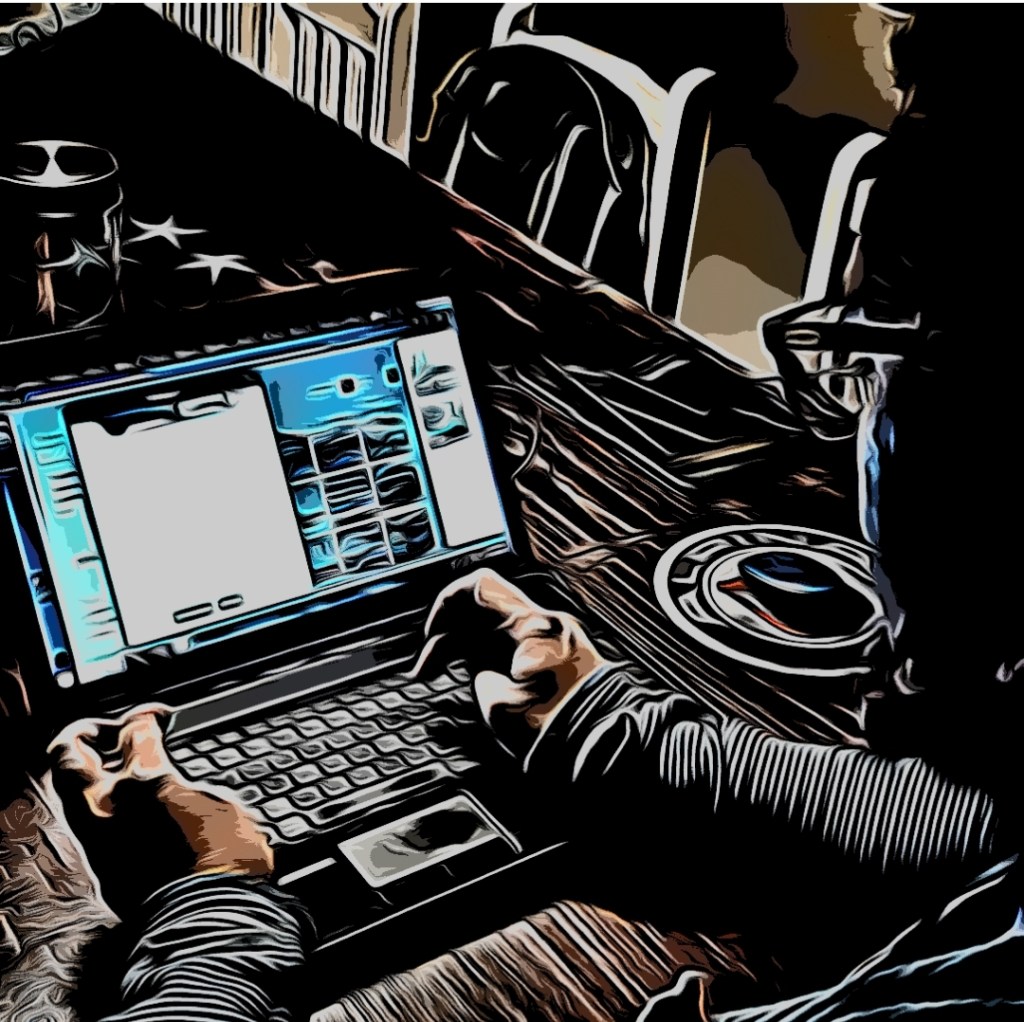
Visual art of a photograph of a human taken by a human
#writtenbyhumanhand
100+100 Words: Since being on the towards-hundred-side of 40, I too started reminiscing on memories of things past. This is not on purpose – it seems to happen by design. I remember an innocent time when children played in mud, climbed trees and collected anything from erasers to stamps and writing block pages as hobbies, and I remember – tearfully – family and friends who are not here anymore. And friends who had emigrated for their “children ‘sake” and are now left by their children. And sometimes I even wonder if the memories I have, are mine or if they’re from books – or made up.
Today we – once innocents – are up against intelligence generated by machines. We have more knowledge available at our fingertips than any generation before us. But it made us lazier, dumber. AI is the next buzz happening and it’s a bigger threat to human creativity and originality than anything ever before. And like the phenomenon of smart phones, we will let it take us over – willingly. But let’s fight back. Let’s do real things again, like crocheting and drawing by hand. Let’s write emails and essays using our brains, because if we don’t – soon we won’t be able to anymore.
10ish-words Takeaway: Live for real in an artificially-driven world, so that you have real memories to reminisce on when old.
I am always amazed by how my characters can surprise me. Just this morning I wrote a flash fiction story. Yesterday the ending of the story popped into my head. I decided to write it on my phone last night whilst in bed, but I was too lazy to figure out the plot details. This morning I decided to sit down and labour over it a bit. I knew the ending was words uttered by a soldier in a war, but I had no idea about how I was going to get there. But when I started writing, Uwe, the protagonist turned out to be a dentist in the German Army during WW2 who was experiencing a crossroads moment. I didn’t make Uwe up. He created himself before my mind’s eyes. All I had to do was to start writing a few words. The moment Uwe was ‘born’, he developed a life and a voice of his own.
The same happened years back when I started writing a novel (which is still only two thirds into the creating phase of the writing process). I wrote a chapter in which the two main characters – a couple – invited a new friend over for dinner. This friend plays the other main character in the story and they were chatting away soon enough. At that stage, all I knew about my couple was that they previously had a relationship, were reunited and were engaged now. During the dinner conversation I learned that they both left South Africa at different times to work on kibbutzim in Israel. They eventually ended up at the same kibbutz, fell in love, got pregnant, lost their baby girl in a bus bomb during an intifada and then the woman went home brokenhearted. They met again years later after she got divorced from her abusing husband and finally had counselling – and were now sitting, engaged to be married, at a dinner table, telling their new friend – and most importantly, me – their whole story. I was flabbergasted by my characters’ secrets. I really didn’t know all those things about them until that scene.
Listen to your Characters
So the moral of the two stories is to learn to sit back and let your characters do the talking – literally! We live in a world of helicopter parenting, controlling our every move to the finest detail and fomo, and writers sometimes tend to overkill on character development to a point of stereotyping (just watch any Hollywood movie) – like the police detective whose boss hates him, is divorced/getting divorced, has a drug/drinking problem, is an absent father and has a heart which is just waiting to attack him. Where are the out-of-the-ordinary detectives who are kind-hearted, crochet with their grandmothers, are happily married, romantic husbands etc? Are they really too boring to write stories about or are we are just too lazy to work out great story lines for them? (And there’s another challenging story idea right there! Don’t steal it – it’s mine!)
We should sometimes just sit back and just listen to our characters telling us who they really are. Maybe they have more to offer than the one dimensional stereotype we so often mould them into.
How do you Listen to your
Characters?
Go about your character
developing the way you normally do. Give them their eye and hair colour, pet
peeves, characteristics, likes, weaknesses, family ties, problems etcetera, as
much as you like, but don’t limit their back stories because of your own preconceptions.
Put them in different circumstances and see how they react. Listen to how they
talk to other characters and to what they tell them. You might be stunned at
what they might reveal. The best way to do this is to sit down and whether you
write to a strict outline or if you are off-the-cuffing it, free write your
scenes. Follow these guidelines.
Don’t
think too much or wait until you have everything figured out before you start
writing. If your character do or say things that you didn’t plan, let him/her without
interrupting or censoring them.
Explore
the character by keep writing. Don’t hesitate if weird things flow from your
pen or keys and don’t stop writing for even a second! And never, ever stop to
correct anything until the free writing is over! Allow freewriting sessions of at
least ten minutes per character.
Write
whatever comes to mind – even if it scares you a bit or if you didn’t plan
things the way it plays out. You can always adapt the story line later or edit
some of what you have written. It is better to have and to do away with than
not to have at all!
Trust
your instincts (or those of your characters), because when you free write, your
instincts take over and most of the time we write better this way than when we
are forced to write according to a plan.
Just
keep going until you reach a point where it feels as if it is done – even if it
takes longer than the time allotted for the session.
Don’t
edit immediately after writing. Leave your work until the next day or even a
few days later. This will give you time to think about the revelations you
characters made and how it will influence the plot and your story line and if
everything still fits in the greater plan. Most of the time you will be
pleasantly surprised. If you really find after rereading your work that it is
not the case or that it really is a bunch of Charlie Romeo Alpha Papa, you can
always delete what you don’t like and/or edit it until you are happy.
Learn to start trusting your
characters to reveal themselves to you. You might discover a whole new approach
to character development for future use.
Awesomest wife. Finest mom. Hopefullest writer. Foreverest dreamer. Living in a coastal village in the Overberg, South Africa, with her husband and two dogs in a small heritage house, and their adult, graduate, job-seeking son in the garden cottage. His CV is available on request. 🙂


 Fielies (Riëtte) De Kock