
Warning: This is a long read.
(Replace ‘Writing’ with your Craft – the Principle Stays the Same)
Written by a human 😉
We, as writers (or any creatives), make a point of learning as much about our craft as we can. And, probably, our greatest challenge is to have a regular writing routine – a schedule to help us to get all our wonderful words onto paper and try to get it published, so that we can entertain people, and in the whole endeavour aim to earn a few bucks. And in doing so realising our dreams. Of course, we have a lot of other challenges, but building a habit of writing regularly is probably the one thing writers struggle with the most, because we are not just creatives – we are normal humans too, with normal human stuff to be done – which can absorb all of our writing time.
I too read and watch a lot of videos about successful writers’ routines to see what and how they do it. And yes, I even saved up some hard-earned money to subscribed to Master Class for a year – which cost A LOT in South African currency.
I’m often jealous of successful authors’ discipline and their productive writing schedules. One writer whose prolificness is really mind boggling to me, is Alexander McCall Smith, who, by the way, is one of my favourite authors – and who I recently had the privilege and pleasure to meet in person in my own little village! I love his beautiful prose and have read a lot of his books so far. He has written more than 100 novels already and publishes four to five books per year in four different series. That’s quite a bit of writing, yes!
During my life so far, I too struggled to have a good writing routine. Most of my writing when I was younger, happened on a Sunday afternoon while most people in the household took a nap. (I’m not a day sleeper.) Since, I had only been partially successful in establishing writing routines of my own – during different phases of my life. And this is what I found influenced my writing routine most in my life – life phases.
This piece is not about identifying or making excuses about not having time. We all have reasons and excuses – lots of them – of which some are very valid and some not that much.
Apprentices in Life
We learn most things in life from watching others. Wannabe writers tend to read about or listen to successful writers’ writing routines and try to imitate them. (There are lots of videos on YouTube about writers trying out the writing routines of Stephen King, Neil Gaiman, etc., in which they then tell what they have learned while trying it.) And although it is important to learn from and imitate the successful best, it’s unfair to compare ourselves to authors who do it professionally for decades already. Some authors write for more than eight hours a day – in different sessions during the day. They do it, because that is what they do for a life. It’s their full-time job.
Unfortunately, for most of us, still living in WannaBeAnAuthorville, hoping to be on the bus to IamASuccessfulAuthor City – still have to steer ourselves through normal family and work life, while trying to achieve our writing dreams.
And this is where the subject of life phases comes in.
Life Phases are Real – Very Real
I started writing before I could even form letters. (Read about it here.) . I toddler-scribbled in a notebook and imagined that I was writing stories. I would even read them to my dolls, all lined up on the couch for story time. My biggest frustration when I was four and five years old, was that I couldn’t write real words yet. In South Africa we only go to ‘big school’ at age six and in my day, in the small town I grew up in, pre-school wasn’t a thing yet.
Eventually the school phase came, and I learned to write and read, and I could finally start to write stories. In primary school, story writing was limited to writing essays in school about ‘My Holiday’ or ‘My Family’. In high school though, we had great language teachers who gave us a bit more challenging subjects to write about. I loved essay writing and even wrote four friends’ essays for them on a regular basis. Unfortunately, I wasn’t much of an entrepreneur, so I didn’t charge them for suddenly getting A’s – as I should have had! But the reward when getting the marks back was payment enough at that stage.
A New Phase – A Life Dream Started
Staying in a high school dormitory, we sometimes had time on our hands, and I started writing stories with friends in exercise books. We were about 15 years old then. The stories were sweeter than honey and drippier than sugar cones, but it didn’t matter because it taught us to start and finish longer pieces of writing. We later had a whole carton box filled with our ‘books’ and it became a small ‘library’, which some of the other girls borrowed to read. Unfortunately, at the end of our high school years we thought our stories too immature (which they of course were) to keep, and discarded of them – which was a pity, because they would have been really cute souvenirs of the humble beginnings of a few wannabe authors. I don’t have intimate contact with my high school ‘author colleagues’ anymore, so I don’t know if any of them still writes, but for a short while in our teens, we were a little society of writers, which felt fanciful. I went on to write and I sell articles and have a few self-published ebooks on Amazon Kindle (link here) but so far that’s it. (The rejection letters gotten from the real publishing industry is the subject of a another piece of writing on another day.)
With that life phase over, I meandered on to studies and work and married life – as most people do. For writers, this phase can be both friendly and enemy-like.
Life Phases – A Writer’s Friend or Enemy?
Life phases are facts of life. Everybody goes through them – no matter what your path is or what life choices you make.
On a friendly note, life phases gift us with experiences, thus, they give us something to write about – something to fall back on when we craft our protagonists and antagonists and side-kicks for the novels we hope will make it big one day. They add depth to our article and blog writing, because without experiencing life, a writer won’t be able to ‘move’ his or her readers. Because only when we really feel as we write, we can make others feel too.
The same argument applies for helping others through our writing. Writing about grief must come from a place of experience, otherwise it would be empty and unbelieving. Writing about falling in love, without ever having being in love, will probably not result in believable writing. Writers need the experience of life phases to be reliable witnesses.
So, life phases help us build the knowledge we need to become trustworthy wordsmiths. No matter how unbelievable one’s fiction ideas might be, if written from conviction, the account becomes authentic.
On the opposite side, life phases keep us very busy and often distract us from writing as regular and as much as we want to. During our student years, we might have time for writing during off times, but our priorities might be focused on totally different goals. And once married and having children and juggling a job in between, we rarely have the time to spend on writing.
Throughout my life, I time and again tried to fight to find regular writing times, while managing the business of life. Oftentimes, I succeeded to an extent and became quite productive – which I enjoyed while it lasted – only to move into a next life phase and having to start all over again!
This happened to me repeatedly and every time one must start from the beginning. And starting over, means getting used to new circumstances and finding time within these changed circumstances and environment to carve out a writing routine of sorts.
Life phases Are not Set in Stone
About a decade ago, I ran a writing club for children, and I wrote regularly myself too. I had quite a rhythm and a routine, all while having a full-time homeschooling teenage son and an ageing parent in the house. I was looking forward to when our son would be finished with school, so that I could fully concentrate on ‘my writing career’. Finally, there was a life phase holding the promise of that!
New Unplanned Life Phases Can Arrive Unexpectedly
One afternoon, my then still-soldier husband came home and announced that we are relocating to another country for his last few years of service. And just like that, we were kicked into another (and unexpected) life phase while managing our son’s final school year ‘on this side’. I had to stop in my tracks again. The writing club had to end and of course, my personal writing ambitions was suddenly limited to journaling, blogging and WhatsApp messaging friends and family. Only after arriving and adapting on the other side, could I eventually get my time organised again. Or a bit at least.
I kept working on my novel, wrote short stories and fell in love with flash fiction (Drabbles – 100-word stories – to be precise). I tried a few things writing-wise, but nothing much successful happened. I started looking forward again to our next life phase, when my husband would be retired, and we would have more time to ourselves. And oh my, did I have plans! Finally, I would have that dreamt-about-plenty of time to just write.
Life phases Are not Set in Stone – Take Two
As it goes with moving from one life phase to another, this new phase took surprisingly much effort to adjust to. Because all those wonderful things one dream of, isn’t all you get. With retirement comes changes. Lots of it! You’re suddenly not working, you feel useless and one wakes up in the dark morning hours with questions such as “What now?” And “Who am I now?” And “What is my purpose now?” And “Do I have any purpose anymore? And eventually, “Am I not to old now to make it in writing? And eventually, “Do I even want to write anymore?”
To suddenly have time on one’s hands is a bit like coming into money unexpectedly and not knowing what to do with all of it. And then you start wasting it, because you have so much of it and you don’t appreciate it enough. Your days become unconstructed, unplanned, unroutined. And they merge into one another without you knowing what you have done the previous one or what you are going to do with the next.
And after many heart-to-heart talks between irritated, unsure spouses, a blessing in disguise happens – Covid. The useless-feeling husband, stripped of crises to handle, suddenly have some crisis to handle and some leading to do and snaps back into becoming his old self again. And slowly the dream life phase turns into a dream again.
So, COVID brought a bit of order for us, where I know it brought chaos and/or disorder and/or grief to many others. As everyone else, we baked and cooked and planted. And like every other writer, I wrote. I wrote blogs with tips on how to survive the tough lockdown. And sent out a series of writing prompts and did a lot of other writers’ prompts myself. Our son and I even co-authored a writing prompts book for petrolheads (link), which we started on a plane somewhere over the Alps years earlier. And slowly I got to a place where I wrote more and more. I even started selling articles again and thought I finally had something going.
Surprise, Surprise – Another Unexpected Life Phase!
And just when I thought that I had a routine figured out, our current dream life phase changed. Again. Opportunity came knocking and we answered and like many people do after retirement, we suddenly found ourselves working again – and just to keep it incredibly complicated, this work took us to another country. Again. Only for three and a half months, they said. We stayed six. And six in the second half of the following year also. So, in practical terms, my writing routine took a two year hiatus. Ouch. Ouch. Ouch.
That was where I found myself writing this. Sitting in yet another country in another life phase – working away from home. And I am unanchored, uncreative, unfocussed, missing our dogs, our home, our town and our wonderful new-found life. The work we were doing was, unlike creative writing, only draining energy and giving nothing (except very welcome monetary compensation) back. It was just tiresome – physically and mentally. Other factors add to the discomfort, like issues with colleagues, heat and very dry and what felt like oxygen-less air, which affects one’s body in various ways. (This sounds like moaning, but it isn’t – it is just sketching circumstances.) I am actually very, very thankful for the opportunity we had to do it, because it rid us of debt we accumulated due to a parent’s dementia care.
Finally Getting to the Point – How to Stay on the Writing Way
So, that was a long introduction to getting to a point of answering the problem stated: How to stay on track during lean writing times?
How do you stay sane and focussed and keep writing when you literally don’t have time to do it? The short answer is – in the same manner one gets any other big or overwhelming task done: By doing it in small quantities, in short bits – or in our case as writers – one word at a time. Because words become sentences, becomes paragraphs, becomes pages, becomes chapters, becomes manuscripts, becomes books.
It’s really simple – but not necessarily easy. If you can’t do something big, do something small – but try to do a lot of it.
I am no expert on anything really – least of all writing success – and I have threatened myself by myself and in public (in our home) to stop trying altogether. Only for my wise husband and beautiful son to tell me that I won’t stop and that I should keep writing, even if I do it just for myself. I found that they were/are right. I cannot NOT write. Even if it is in down times and I only write (very) irregular entries in my journal (electronically). But I keep writing. And yes, unfortunately, apart from a few sold articles etc., I still only write for myself. And that is okay. For now. Maybe, just maybe one day someone will pay to read something (like a novel) of mine.
In his MasterClass, David Baldacci says that every person that should be a writer, will be a writer. I didn’t breathe for a few moments when he said that and I’m still not sure if this encourages or discourages me, but somehow, I find peace in those words. In the meantime, I will continue to write. Maybe, who knows – if I should be a writer, I will be.
So, how do we Practically Keep Writing in Times that we can’t Really do it or don’t have Time to do it?
Fortunately, I am blessed with the ability to be able to concentrate anywhere and that helps me to at least be a bit creative (with the emphasize on ‘a bit’). Because if I’m not creative, I go a teeny-weeny bit mad. I always must have something to do. When sitting in meetings, I doodle. When talking on the phone, I doodle or play a non-thinking game. When watching TV even, I am crocheting or knitting or drawing or designing on Canva. So, while working on this energy sapping project, I’ve decided that I need to make time to do some creative writing – even when there is no opportunity to take hours or days off to write. This is where one must have a bit of a criminal mind, because if you don’t have time and cannot make time – you have to steal it!
This is literally what I was doing writing this. While my very capable colleague was presenting the class, I wrote this. Fortunately, I don’t need to interact in any way in the class, so, I stole this ‘dead’ time to create something. For my sanity. And for the sanity of those round me.
Normally, while on a road trip, working, or in a meeting or just before going to sleep, an idea would present itself out of the blue, and I will just grab my notebook or open my WhatsApp writing group I have with myself, and I would act on the idea. I wrote an 18-page children’s story (by hand) while sitting in a lecture the other day. (I had to attend, but the lecture wasn’t presented on my behalf – so no harm or disrespect there.) I then went on and wrote three more stories of the same length in the days following! On many other occasions I would spend five minutes to write a quick flash fiction story (like a Drabble). I’ve amassed quite a few so far. I’m intending of self-publishing an ensemble in the very near future.
Create Every Day – even if it is Minute!
So. I try to do something creative everyday – even if is something very small. To do this I create do-able goals and keep record of my daily creative processes. At the end of each month, I look at the record I kept for every week. If one is successful in writing something (no matter how little) only twice a week for a month, you already have a bit of a routine – and that is an amazing achievement in lean writing times! Not only do you build up ‘stock’ for you writing ‘enterprise’, but seeing that you have at least accomplished something, is very good for the mood and one’s overall mental health in general and there are ways to keep going!
Ideas for Small Writing Projects if you can only Manage to Steal Small Moments of Time
- Keeping a personal journal is the best way to help you create a daily writing routine. Choose a time of day (or even week) when it is convenient for you to write, but keep to it maybe for before going to bed or first thing in the morning. Or set an alarm at a convenient time of day. That way it will eventually become a habit (while working your way up to a daily writing routine). Many a diary entry of mine had turned out to become blog entries, and basises for writing articles and stories. Journal entries doesn’t have to be pages long. Two sentences will suffice. And if you don’t write for a week or a month or even two – don’t stop! Just keep going on where you left off. It’s your journal after all!
- If you love writing poetry, try writing one short verse of poetry every day, until you have a whole poem at the end of the week or weeks. If you don’t or never have written poetry, try your hand at it. It will build new brain paths and even make you feel better (more productive). Poems also help when we have a bit of blues – so explore your poetic side a bit.
- If you’re a fiction writer, write flash fiction. Set a goal to write one flash fiction story every day – or just every day of the week/weekend for a start. It might be anything between six and 500 words. If you manage to steal more time, write one or two more for the day, it will help you to have a stash of new stories at the end of this dry time, and – when you finally get out of it, you have something to show. Lean writing periods are perfect flash fiction ‘stock building’ periods. Some of these flash stories, might even become the basis for something longer.
- Another piece of writing that doesn’t have to be very long is character writing descriptions for a story that you are busy working on or want to write. Working on this will help a lot when you finally get to write the story, and then half of the work is already done.
- Have your notebook with you at all times and when you have quiet time or is bored during work time, and you can get away with it, think about ideas for stories and jot them down immediately. (Because by tonight or tomorrow you will have forgotten it!)
- Use a few minutes per day and think of plot ideas for the story ideas that you already have jotted down in your notebook. These plots don’t have to be set in stone. They are just initial work to get yourself thinking about your story. This way you give yourself time to brood on plot difficulties and fix problems. It doesn’t matter if the plot lines suck initially. Fixing them is wayyy better than having nothing to fix! When you have a plotline going, start working on an outline for the story.
- If you are really stuck and don’t know what to do, look on the internet for writing prompts or just open the nearest book you have close to you and choose the first sentence you read, as the start or finish for a flash fiction/short story. Alternatively, do some of the prompts in this exercise – https://fieliesdekock.com/category/on-writing/.
Get Doing!
It doesn’t really matter what you write – as long as you make time every day to write just a little bit and on the days that you don’t write, do something creative, such as needle work, gardening, model building, Lego building, painting, etc.. Cook or go for a walk or a swim, listen to music or visit a friend (or make that call to a friend you have put off for so long). Walking is very good for letting one’s thoughts just flow and often when walking, we relax and the things that bothers us, just resolve itself in our brains and thoughts. This is a good time to get plot issues resolved. Long or shortish road trips also does the trick for me.
Whatever you choose to do – just do something! It will surprise your brain and your body and soon enough the creative juices will be flowing again. Agatha Christie used to say that ideas come to her and plot issues solved themselves while she washed the dishes. If you’re desperate, try it!
In lean writing periods like the one I was in now, it makes no sense to set big, unmanageable goals. We all know that unrealistic goals lead to disappointment and dejection. Spare yourself that. You ARE NOT a superhuman. Stop treating yourself like one! Before I get too preachy, I will rather end with a quote:
Small things over time, can get big. (Austin Kleon from his book, Show your Work)
As I mentioned above, I stole time here and there to write this blog post during a really, really busy time. It is a testimony, to proof to you that I know what I’m talking about and that it can be done! No matter how busy we are – we CAN find five minutes EACH day to write something – even if we have to write a long piece like this, word for word, paragraph by paragraph every other day.
No apologies. No excuses. Just write – wherever, whenever.
PS: Doggy Bag/Take Away
Whenever we write articles or blogs trying to advise or teach people things – writers can make it sound so easy. But – to turn something into a success never comes easy. Most things worthwhile in life takes effort, self-discipline, routine and resilience.
(Remember this formula: Success = self-discipline + routine x repetition)
Realisation of one’s dreams does not happen while sleeping in daily, lying on the couch watching TV or playing games (and fulfilling other people’s greedy dreams). For dreams to come true – we actually need to do the work. No one else is going to hand us anything for free – or offering us our dreams on a plate, because they are too busy realising their own. Only we, ourselves, are responsible to work towards realising our dreams.
Success (like respect) isn’t inherited or gifted.
It is earned.
© 2025 Fielies De Kock
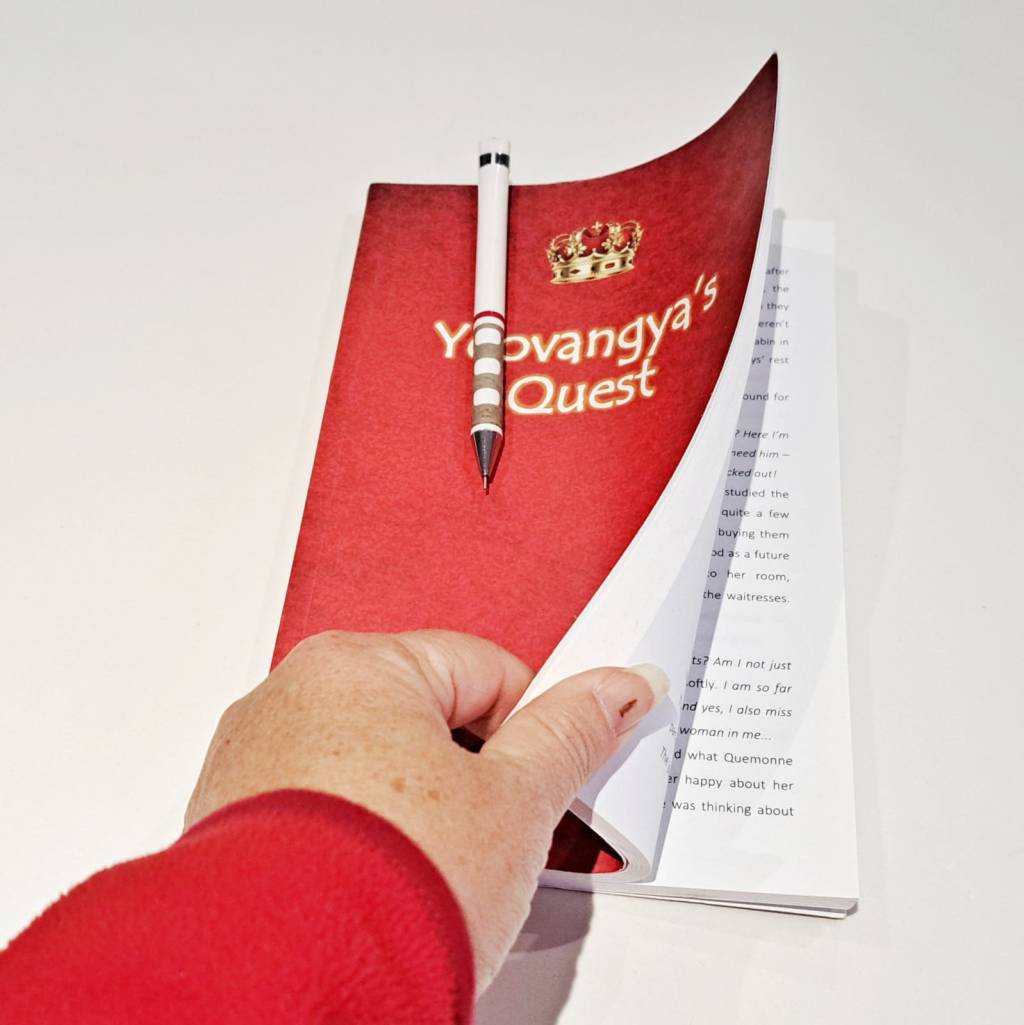
Fielies De Kock is a freelance content writer/blogger (www.fieliesdekock.com) living in Hermanus in the Overberg, South Africa, with her crazy-haired husband and two dogs. She authored a children’s chapter book and a few short reads and is co-author of 125 Creative Writing Prompts for Petrolheads (available on Amazon Kindle) with her content writer-morphed-into-estate agent son – who also has crazy hair.

 Fielies (Riëtte) De Kock